Search “Vietnam vs. India vs. Philippines offshore” and you’ll find roughly a hundred comparison guides.
I’ve read about twenty of them since I landed in Ho Chi Minh City fifteen years ago. Cost per hour, English proficiency scores, engineer headcount, time zone overlap, working days per year. Tables with stars. A neat conclusion at the bottom that says, “overall, Vietnam wins.”
At some point I stopped reading them.
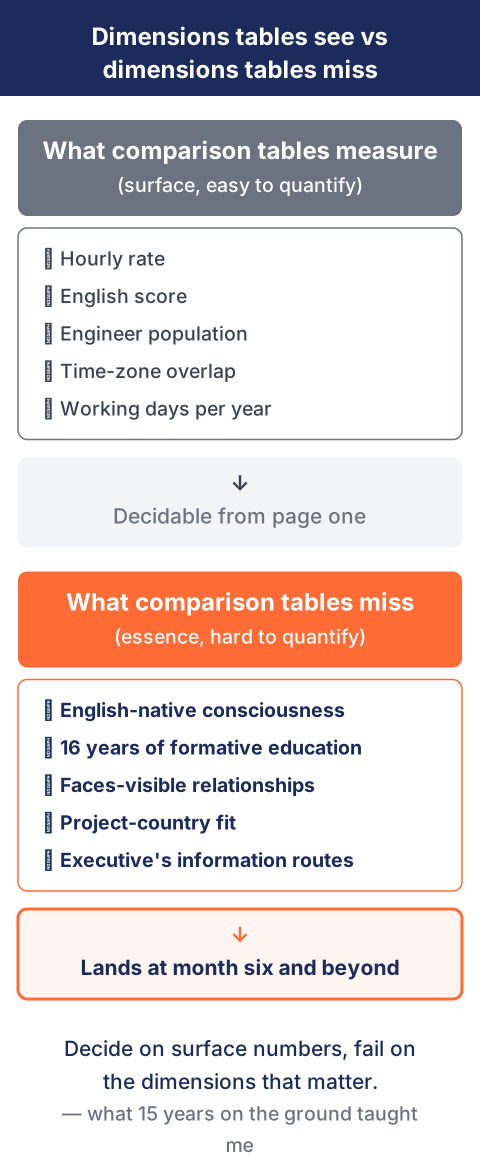
What those tables measure and what actually decides whether a project succeeds are two different things.
This isn’t a “pick Vietnam” article. Running projects across many countries, I’ve seen ones where India was the right answer, and ones where the Philippines fit better. What I want to share are the five questions I use in place of comparison tables.
The short version of the AI talent comparison, before anything else. The figures below count IT and tech workers in general (including BPO in India and the Philippines), not AI engineers specifically. India has by far the largest pool: about 5.8 million people across its tech and BPM industry, roughly ten times Vietnam’s. Attrition in its IT-services segment still runs at 19–20%, though sector-wide voluntary attrition is about 12%. The Philippines’ IT-BPM sector employs about 1.9 million people, but most of that is BPO and voice work, and attrition runs at 30–40% industry-wide, dragged up by BPO churn; dedicated dev teams run lower but still elevated. Vietnam has about 560,000 IT professionals, and 55,000–60,000 students enter IT-related degree programs each year. Recruiters put its tech attrition at around 10–15%. Each country measures attrition differently, so the three figures don’t compare cleanly. On Oxford Insights’ Government AI Readiness Index 2025, India ranks 27th of 195 countries, the Philippines 43rd, and Vietnam 45th, last of the three. That index scores governments. It says nothing about the engineers you are about to hire. Sources and the full tables are in the next section. The rest of this article is about why I stopped deciding on these numbers.
What Comparison Tables Don’t Show You
First, a fair disclosure: the items in standard comparison tables aren’t wrong. Hourly rate differences are real. English score gaps are real. Engineer population counts are real.
So before I tell you why I stopped trusting these tables, let me give you the numbers people come here for. This is the honest 2026 snapshot, from sources I actually use, including our own rate data:
The 2026 numbers everyone asks for
| 2026 snapshot | Vietnam | India | Philippines |
|---|---|---|---|
| Tech talent pool | ~560,000 IT professionals; 55,000–60,000 students entering IT-related degree programs a year (TopDev 2024–25) | ~5.8 million across the tech and BPM industry — roughly 10× Vietnam (nasscom, 2025) | IT-BPM sector ~1.9 million, but the majority is BPO/voice work; software engineering is a much smaller slice (IBPAP, 2025) |
| Typical vendor rate (mid-level) | $25–60/hr in our own 2026 client work; market guides quote $18–50 (our full cost breakdown) | $20–45/hr — the widest spread of the three, from bargain body shops to premium consultancies | $18–40/hr, with a premium on English-heavy roles |
| Attrition (tech roles) | ~10–15% by recruiter estimates | IT-services segment still runs 19–20% (2025); sector-wide voluntary attrition ~12% (nasscom) | 30–40% industry-wide, dragged up by BPO churn; dedicated dev teams run lower but still elevated |
Sources: TopDev Vietnam IT Market Report 2024–25 · nasscom Technology Sector Strategic Review & Compensation Survey 2025 · IBPAP / industry reporting on the Philippine IT-BPM sector (2025) · Linnoedge client-rate data. These are ranges, not gospel — quotes vary by role, seniority and engagement model.
Where the three countries rank on AI readiness (2025)
On Oxford Insights’ Government AI Readiness Index 2025, India ranks 27th of 195 countries, the Philippines 43rd, and Vietnam 45th. I run a development company in Vietnam, and Vietnam comes last of the three. It does lead one pillar, Governance, where it scores 88.05 against India’s 64.03.
| AI readiness 2025 | Vietnam | India | Philippines |
|---|---|---|---|
| Overall rank (of 195) | 45th | 27th | 43rd |
| Policy Capacity | 53.50 | 96.00 | 84.50 |
| AI Infrastructure | 57.41 | 63.31 | 49.50 |
| Governance | 88.05 | 64.03 | 83.34 |
| Public Sector Adoption | 73.21 | 79.07 | 69.17 |
| Development & Diffusion | 47.03 | 54.85 | 43.96 |
| Resilience | 43.28 | 59.46 | 58.17 |
Source: Oxford Insights, Government AI Readiness Index 2025 (195 countries; 69 indicators across 14 dimensions in six pillars). In the six pillar rows, bold marks the highest score of the three; on the rank row a lower number is better, so no score is bolded there. For regional context, Vietnam sits fifth among the eleven ASEAN member states on the same index, behind Singapore (7th), Thailand (34th), Malaysia (38th) and the Philippines (43rd). (Timor-Leste joined ASEAN as its eleventh member in October 2025 and ranks 179th.)
What this index measures is governments, not vendors. It scores national policy, public-sector AI adoption and infrastructure. It says nothing about whether the eight engineers you are about to hire can ship your product. Singapore ranks 7th, and that is not a prediction that any given Singaporean team will hit your deadline.
Vietnam’s 45th place is not a flattering number for us. If national rankings were the right way to pick a partner, it would be an argument against hiring my company.
But decide on those numbers alone, and you may come to regret it later.
There are a few reasons. None of them show up in the comparison tables I’ve read.
First: how the team relates to English.
People from India, the Philippines, Singapore, and Hong Kong sincerely believe their English is native English (and to be fair, it mostly is — their grammar and vocabulary are far better than mine).
But that “I’m a native speaker” feeling comes with a side effect: it rarely occurs to them to slow down for the listener. They speak at their own pace, in their own accent, and genuinely can’t see why it isn’t getting through. It’s hard to imagine a second-language learner’s struggles when you’ve never been one.
Vietnamese engineers approach English differently. Their pronunciation isn’t native, but they adjust to the listener’s pace, probably because they know from experience what it’s like to work in a second language. I used to take that for granted. It doesn’t happen everywhere.
Second: sixteen years of formative education.
Primary school through university adds up to about sixteen years. What gets repeated for sixteen years becomes the base of how a person sees the world.
Some countries spend those years teaching “don’t trust Japan.” Others teach coexistence with the outside world as the default. Some teach anger as fuel. Others teach calm resolution as the path of strength.
Sixteen years produces a set of values that sits deeper than language. No comparison table has a column for it, but once a project runs past six months or a year, it starts to matter.
Third: whether you can build a “faces visible” relationship.
I’ll come back to this one later. It’s probably the most important part of this article.
And one more: the fit between the project and the country.
It’s not about which nationality is superior. Depending on the nature of the project, the national character that suits it changes. More on this later too.
These four are the kind of thing the stars in a comparison table can never tell you.
The Day I Heard the Word “Keinichi”
Fifteen years ago, fresh off the plane in Ho Chi Minh City, a senior Japanese expatriate businessman said to me: “Vietnamese people are keinichi (敬日).”
Not shinnichi (親日) — friendly to Japan. Keinichi — respectful to Japan. The character is the one for reverence.
I didn’t fully get it then. Now I think it’s exactly right.
Across ASEAN, Vietnam is the country that holds Japanese people and Japanese institutions in the highest regard. This isn’t just my impression. Almost every Japanese expat I know in Vietnam says the same thing, unprompted.
Why does that exist? My theory: at the foundation sits an inherited trust in Japanese products. Things that don’t break. Quality you can rely on. Reliability that earned a reputation over decades. If the products are this good, the people making them must be serious people too. That kind of inherited trust runs deep here.
We’re working on top of a foundation that earlier generations of Japanese businesspeople built by quietly doing their work well, for decades. No comparison table will tell you that. Every workday in Vietnam, I feel it.
A small confession: my first attempt at offshore development wasn’t actually in Vietnam. It was in another country. What I felt there was that working with a country that doesn’t respect Japan is fairly hard. Not for technical reasons — for reasons that sit deeper than that.
→ Related: The Japanese Quality Trap: Vietnam Expansion on Hard Mode
When India Won, and When Vietnam Won
From here, the part that gets overlooked the most.
It’s about the fit between the project and the national character.
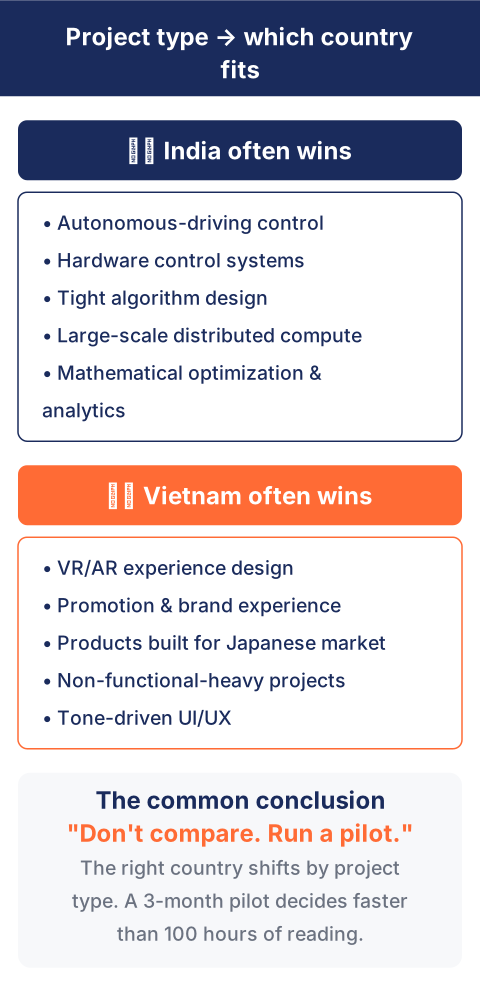
I’m currently working on an autonomous-driving project with a team in India. Indian engineers are genuinely logical. Hardware control, building precise systems step by logical step. Many of them are excellent at that kind of work.
Their proposals and design documents are excellent. Airtight logic, no gaps.
That said, on the emotional side we sometimes don’t quite meet, and communication can become one-way. A lot of “here is what I believe.” Not the rhythm I’m used to — say one sentence, read the listener’s face, then the next. I think that tendency is common across English-native cultures.
Their documentation is the same. Logic front and center. Genuinely impressive.
Now, the other side.
I once worked with a Vietnamese team on a VR headset project for a major Japanese consumer electronics maker. I still think that was work only Vietnam could have done for us.
VR is a stack of non-functional requirements. “How will a Japanese viewer feel watching this?” “Does this tone of voice land?” “Is this beat funny to a Japanese audience?” None of that fits into a written spec. It’s a long sequence of judgment calls.
Vietnamese engineers have a strong drive to understand “what do Japanese people find compelling?” That posture connects back to keinichi.
So as a rough guide, it looks like this:
- Logical, precision-heavy, hardware-bound systems → India often wins
- Context-sensitive, taste-driven, end-user-experience work → Vietnam often wins
Neither one is “the right answer.” Choosing to match the nature of the project might be the better way to go.
→ Related: Three Countries, One Career / Japan Regulated Gaming Data Platform case study
The 5 Questions I Use Instead of Comparison Tables
Here’s the part of the article I most wanted to share.
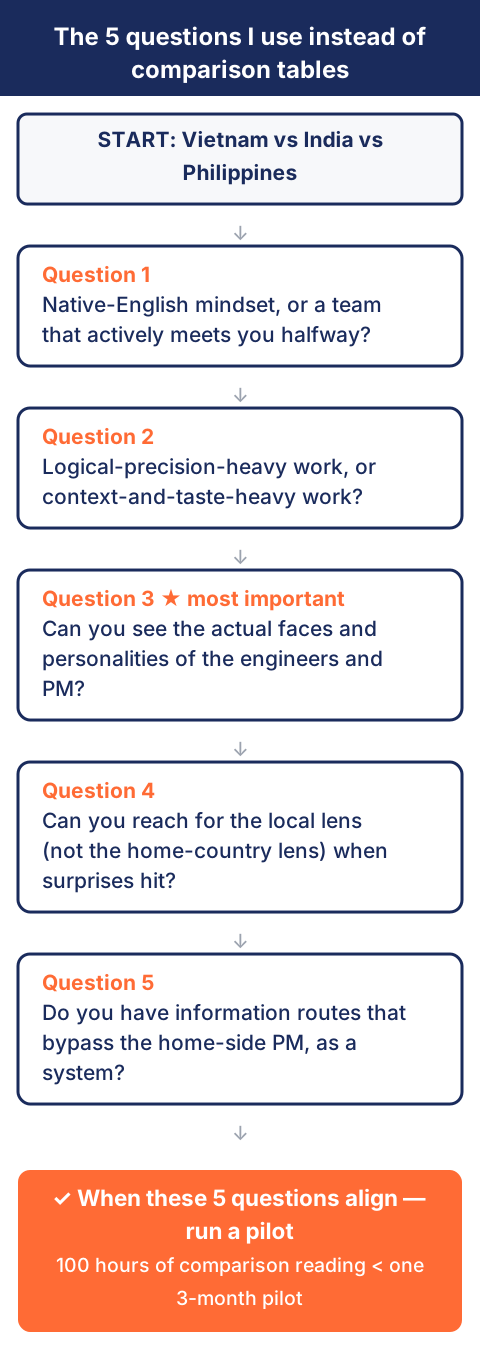
When a new client asks me “Vietnam, India, or the Philippines — which should we pick?”, there are five questions I ask in return.
Question 1: Would you rather work with a team that thinks their English is perfect, or a team that actively works to meet you halfway?
This one question alone settles about half the direction.
Question 2: Is your project core logical and precision-heavy, or is it context-and-taste-heavy?
If the core is hardware control and precise algorithms, India. If the core is product experience and tone, Vietnam. Even inside the same phrase, “software development,” this angle turns out to matter.
Question 3: As an executive, can you build a route where you can see the actual faces and personalities of the engineers and PM on the other side?
This is probably the most important one.
Remote is fine. A relationship where you can talk in names and faces: “Le-san is managing this,” “Van-san committed that code.”
Why does it matter? Because when the engineer on the Vietnam side can see that “if I slip here, that person at that company in Japan is in trouble,” they find one more push at the end.
At the very end, one more push comes out.
That push doesn’t appear when the customer’s face is invisible. Building from a spec sheet alone and building while seeing the customer’s face are two completely different jobs.
→ Building this “faces visible” relationship as a system is exactly what we do at System Development (offshore lab).
Question 4: When the unexpected happens, can you reach for the local solution instead of the home-country solution?
When you operate across borders, “no way” moments happen that simply wouldn’t at home. A regulation that changes from next Monday. An undersea internet cable cut by a certain country. Or just a power outage…
Try to solve those with your home-country playbook, and you get stuck. Understand “here, this is treated as this kind of problem,” then solve it the local way. People who can make that switch are the ones suited to overseas development.
Question 5: Have you built information routes that don’t pass through your home-side PM?
I’ll cover this one in the next section.
The Real Trap: Why Mid-Size Companies Fail Offshore — The Information Route Problem
The pricing trap and the language trap get talked about a lot. The one where I keep thinking “so many companies fail exactly here” is a third trap:
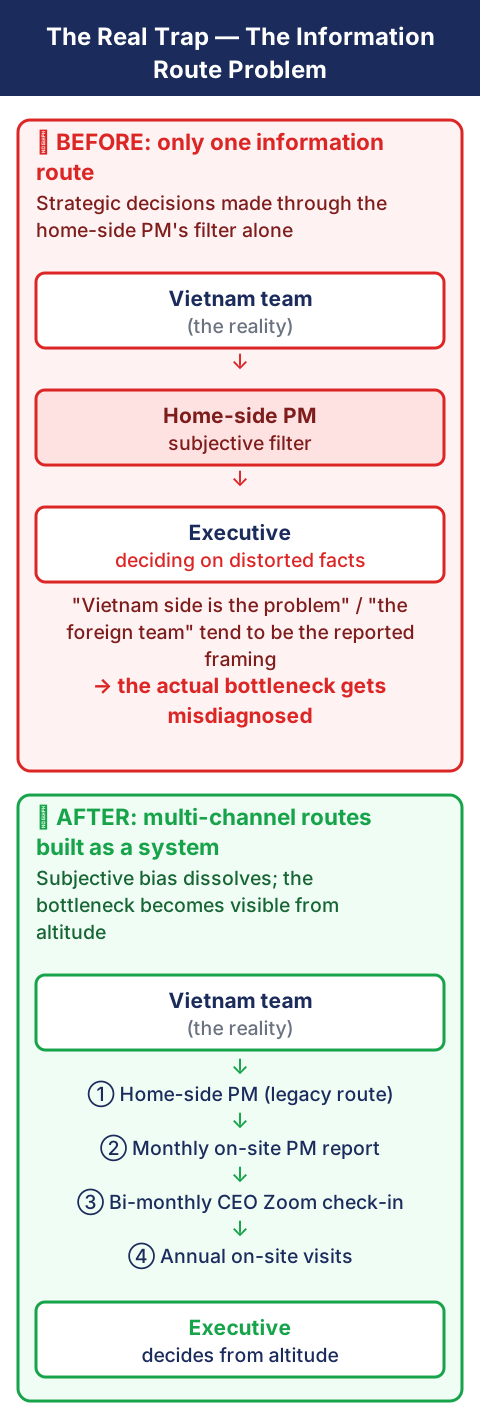
The executive delegates everything to the home-side PM, and stops looking.
It happens a lot, and it’s a real waste.
“The PM handles it. I don’t understand the technical side anyway.” But when field information only reaches you through the home-side PM, the picture you get starts to skew.
Honestly, home-side PMs tend to report problems as “the Vietnam side is the problem” or “it’s because they’re a foreign team.” From the PM’s seat, that’s the simplest way to wrap up a report, so it’s the easy thing to say.
But the executive, working off that filtered report, can’t tell what the actual bottleneck is.
The executive chose offshore for a strategic reason. Without someone who can see the project from that altitude, the conclusion defaults to “well, offshore didn’t work after all.”
I think there are two fixes.
One: show up in person.
When the executive comes once or twice a year and makes time to eat with the engineers, the project goes well to an almost strange degree. I think it’s because the firsthand information you can’t get over Zoom all arrives right there.
Two: build an information route beyond the home-side PM, as part of the structure.
A monthly report that goes from the on-site PM directly to the decision-maker works. So does a CEO check-in every other month.
With only one information path, every judgment gets filtered through that one person’s point of view.
Hold a route that lets you see the whole board, built into the structure. If you’re doing overseas development as a management decision, I think that’s a hard requirement.
→ Related: Pre-launch Vietnam market research
Stop Comparing. Run a Pilot. And Don’t Give Up Easily.
This got long, so let me wrap up.
The Vietnam vs. India vs. Philippines comparison tables you see everywhere aren’t wrong. They’re just not looking at the things that decide the outcome.
The English-native mindset, sixteen years of formative education, faces-visible relationships, the project-country fit. None of these appear in any column of a comparison table, but once a project runs past six months, they always start to matter.
So when a new client asks me which country to pick, my answer is always the same:
“Don’t compare. Run one small pilot.”
Run a small trial project for about three months. Decide from that. Reading ten more comparison guides teaches you less. Actually teaming up once tells you the most.
One last thing.
When you work with teams overseas, the truly unexpected may happen. (Though if you run software projects, “no way” moments happen at home too…)
When those moments come, I’d ask you not to let your first reaction be “ah, this doesn’t work.”
Treat it as a problem that doesn’t happen at home, solved in a way you wouldn’t use at home. If you can flip that switch, it can probably be solved.
Don’t give up so easily.
That’s it.
Frequently Asked Questions
Q1: Vietnam vs India offshore comparison 2026 — which is actually cheaper?
Hourly rates in India can run lower for certain regions and skill brackets. Total cost, however, depends on communication round-trips, rework from spec ambiguity, and PM overhead. Projects centered on tight logical engineering capture the India hourly-rate advantage cleanly. Projects centered on context, taste, and end-user experience often come in cheaper overall in Vietnam, where rework cycles are shorter and the team leans into Japanese product sensibility.
Q2: Which AI integration companies in Vietnam offer consulting on choosing and integrating off-the-shelf AI solutions?
A handful of Vietnam-based firms now offer this consulting layer — choosing among off-the-shelf LLMs, RAG vendors, and managed AI platforms before committing to integration. Linnoedge provides this through our AI Solutions Consulting practice, combining a 15-year track record of Japan-Vietnam delivery with vendor-neutral evaluation of LLM, vector DB, and orchestration choices. Selection criteria typically include data residency requirements, regulated-industry compliance, and total cost over a 24-month horizon.
Q3: How should I evaluate a Vietnam offshore partner before committing?
Three criteria matter more than skill assessment spreadsheets. First, can you talk directly to on-site team members without the home-country PM as a filter. Second, does the partner reach for local-context solutions when the unexpected happens, rather than forcing home-country playbooks. Third, are the contract exit conditions and knowledge handover terms written out in advance. Skill is replaceable. These three are structural. For a longer checklist, see our guide to choosing a software outsourcing company in Vietnam.
Q4: What should an executive decide first when starting offshore lab development?
Decide your information routes. Build at least one channel that doesn’t pass through the home-country PM — a monthly written report from the on-site PM to the executive, a bi-monthly Zoom check-in, or annual review trips. Single-route information means single-person interpretation, which is too narrow a basis for strategic decisions. This is the structural fix mid-size companies most often miss.
A 15-minute free conversation
If a “faces visible” model of offshore development is interesting to you, I run a fifteen-minute conversation. It isn’t a comparison-table conversation. It’s working out together what actually matters for your specific project.
Book a 15-minute call →Related reading

Shogo Harada原田 祥吾
CEO · Linnoedge Inc. · LinkedIn↗
Operating IT offshore development and overseas expansion support businesses across two bases: Tokyo and Vietnam. A leader who believes in “Systems over Spirit,” structuring cross-border businesses that often tend to be opaque. Committed to providing “reproducible quality” to organizations and clients rather than relying solely on individual skills.