
Have you ever looked at a perfectly generated bug report from ChatGPT and wondered: “If AI can do all of this, what is left for me?” If you work as an IT Communicator or a Tester, you have probably asked yourself this exact question. In my current project, I sit right between the client and the development team, which means I need to understand both the business side and the technical side perfectly.
Recently, I started integrating AI into my daily workflow. What I discovered completely shifted my perspective on my career. I want to share how AI is not replacing my job, but rather fundamentally changing how I work.
The Traditional Role: More Than Just Communicating
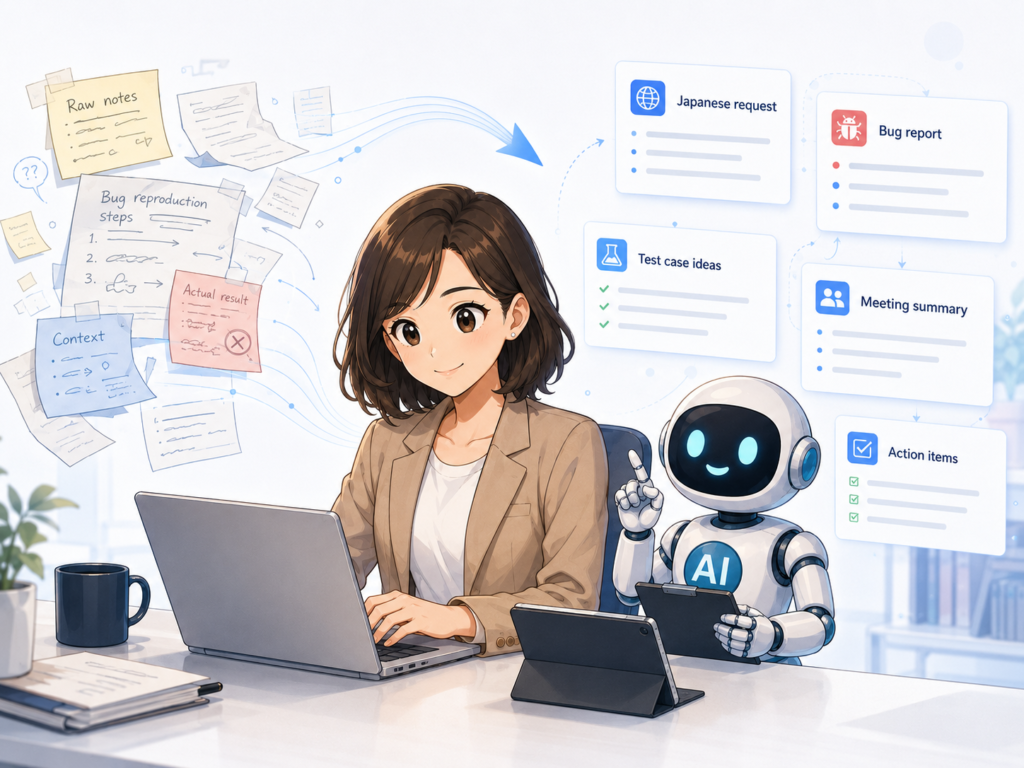
Before the AI boom, my job was mostly about making sure things were communicated correctly. My daily tasks looked something like this:
- Translating requirements: Receiving business needs from clients, often in Japanese, and explaining them accurately to our developers.
- Writing bug reports: Documenting issues clearly so developers can easily understand and replicate the problem.
- Creating test cases: Reading through technical specifications and designing realistic testing scenarios.
- Meeting management: Taking detailed notes and summarizing action items for the team.
It might sound straightforward on paper, but in reality, it is a highly stressful position. A single tiny misunderstanding in wording can easily lead to miscommunication, incorrect code fixes, or massive rework for the whole team.
My First Steps Using AI in Software Testing
At first, I only trusted AI with small, repetitive tasks. I used it for rewriting Japanese sentences to sound more natural, or just getting a few formatting suggestions. But over time, I found myself relying on it almost every single day.
How AI Speeds Up Bug Reports and Test Cases
Whenever I encounter a bug now, I simply jot down the raw details:
- Reproduction steps
- Actual results
- Relevant context
The result is amazing. In just a few minutes, AI generates a highly professional and solid bug report draft.
When I receive a new feature requirement, I ask AI to suggest test cases. Surprisingly, it often comes up with edge cases that I had not even thought about. After long meetings, I use it to summarize discussions and extract action items instantly. Honestly, AI has saved me countless hours, especially when it comes to writing and organizing heavy technical information.
The Turning Point: What is Left for Me?
After relying on AI to draft test cases and bug reports for a while, I hit a mental wall. I honestly asked myself what my value was if AI could write faster and brainstorm better than I could.
After using it deeply across multiple sprints, the answer became very clear. AI is not replacing my job, it is just changing the nature of my work. Before, my main identity was a translator and a communicator. Today, my role has evolved into three distinct new pillars.
Redefining My Role: The Bridge Between AI, Developers, and Clients
1. The Output Validator
AI writes incredibly fast, and it usually sounds confident and correct, but it is not always right.
- It misses system-specific context.
- It misunderstands complex business logic.
- It lacks crucial project-specific details.
If I do not catch these hallucinations or omissions, both the developers and the clients will suffer the consequences. My new job is to be the final gatekeeper of quality.
2. The Context Provider
Here is the biggest lesson I have learned so far: AI is only as good as the context you give it.
My main skill is no longer just writing well, but structuring information effectively. Let me give you a real-world example of how context changes everything:
Bad Prompt: “I cannot register a case. Please write a bug report.” (The AI output here will be generic, guessed, and completely useless for developers).
Good Prompt: “Act as a QA tester. Write a detailed bug report for the following issue: On the Bizon environment, after yesterday’s release, users cannot register a new case. The related API returns a 400 error. Please include reproduction steps, expected results, and actual results.” (The AI output here will be highly accurate, targeted, and ready to use).
3. The Human Bridge
AI does not understand what the client is truly concerned about. It does not know the business priorities, the political nuances of a project, or the real-world deadlines we are facing.
Developers need clear, precise, and highly technical information. Clients need simple, business-focused explanations. I am still the human sitting right in the middle. I take the AI’s output, refine it, and deliver it with the exact tone and focus that each side needs to hear.
Final Thoughts: AI is the Assistant, You are the Owner
Looking back, my job used to be about writing correctly and communicating clearly. Today, it has become about understanding deeply, structuring information better, and leveraging AI effectively.
To me, AI feels like a highly capable junior teammate. It is incredibly fast and knowledgeable, but it still needs strict guidance and review. AI can help you write the perfect first draft, but it cannot take responsibility for the final outcome. You are the one who does that.
And honestly, that is exactly the kind of elevated role I am excited to grow into.
What about you? Are you an IT Communicator, QA, or Tester using AI in your daily tasks? Do you see it as a helpful assistant, or do you still worry about it replacing jobs in our industry? Let me know your experiences!
We cover related ground in a permission-aware enterprise RAG we built.
For the consulting frame on this, see Linnoedge.
Related reading
- Top 5 IT communication mistakes (and how to fix them)
- Why all tests pass but code still breaks in production
- The new shape of SI companies in the AI era: Forward Deployed Engineering
Working out where AI fits your team?
I run my own company on AI every day — the wins and the misfires included. If you’re deciding what to hand to AI and where people stay in the loop, a free 15-minute call is a good place to start. Not a pitch — just thinking it through together.
Book a 15-minute call →
Akibi PhuongAkibi Phuong
IT Coordinator · Linnoedge Inc.
Turning client ambiguity into developer-ready clarity — across 6+ projects, 150+ bugs caught before release, and AI-powered workflows that keep delivery smooth, smart, and drama-free.