
Hi, I’m Shogo Harada, CEO of Linnoedge, writing from Ho Chi Minh City.
A few weeks ago I couldn’t stop thinking about something Brandon K. Hill, CEO of btrax, posted on X. His argument: design agencies are failing at a rising rate worldwide, and AI alone doesn’t explain it. He closed with a question: what does a design firm actually sell? Probably not the product.
The moment I read it, I knew it applied directly to my own industry. Swap “design firm” for “software vendor” and the question still holds: what does a software company actually sell? This article is that question, run against what we actually do every week at Linnoedge. I’ll tell you upfront: the answer is smaller and less heroic than you’d expect.
The same numbers show up in my industry
If this were only about design agencies, it wouldn’t have kept me up. But the numbers say it’s happening in my industry too.
Tokyo Shoko Research (one of Japan’s major corporate credit research firms, the kind banks and investors use to gauge company risk) tracked 166 bankruptcies in Japan’s information services sector in the first half of 2026. That’s up 18.5% year-over-year, the highest count in a decade. More than 80% of those failures (135 companies, or 81.3%) were businesses with fewer than five employees, itself up 25.0% year-over-year.
Tokyo Shoko Research’s own read on the cause: the spread of no-code, low-code tools and generative AI has let clients bring simple content and development work in-house, and that’s turned into a headwind for the small operators who were competing mainly on price.
Work that just follows instructions is work a client can increasingly do without you. It makes sense that the failures cluster at the smallest end of the market. That’s where it hit first. I’m writing this like it’s someone else’s problem, but we still take on build-to-spec work too.
What clients are asking for has changed
I’m not saying programmers are becoming unnecessary. What I mean is narrower: the need for a programmer who only builds exactly what they’re told, nothing more, is shrinking. People who can design a system, understand an industry’s actual pain points and turn them into a fix, people who can tell whether the thing they built will actually hit the KPI. That need isn’t going anywhere.
Something close to the same shift shows up in US hiring data. Indeed Hiring Lab’s Software Development job postings index, published through the St. Louis Fed’s FRED database, set February 2020 at 100. It peaked at 233.84 at the end of February 2022. As of July 24, 2026, it sits at 75.48, down to less than a third of that peak.
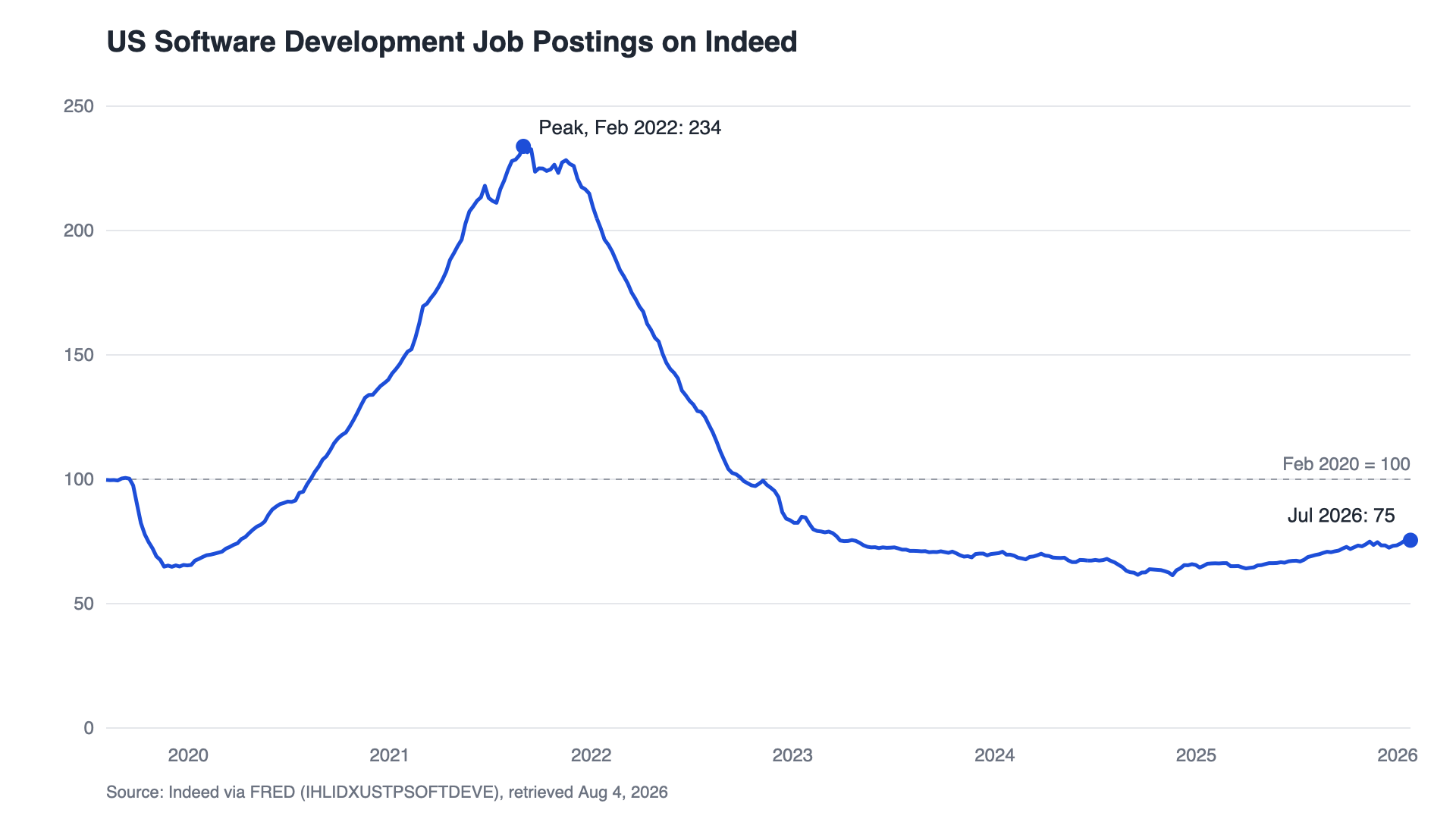
It has crept up a little from its low of 65.86 on July 24, 2025, so demand hasn’t disappeared. What’s changed is where it shows up, and what kind of work it’s asking for.
What clients ask a software vendor for isn’t build-to-spec-and-done anymore. If there’s a better way to hit the goal, they want to hear it. Understanding what the client actually needs well enough to exceed it. Underneath that, being someone they actually want to keep working with. That second one matters more than I expected. And the place that shows up most clearly is the weekly sync I’m about to describe.
So what actually happens every week
This is the part I most wanted to get to.
What we sell lives inside the weekly sync. We run lab development, not contract development, so this happens on the same day, at the same time, every single week.
What we did last week. Problems that came up. Problems surfacing on the client’s business side, not just ours. How much of that we picked up and folded into the following week’s work. That’s the real content. There are always trade-offs inside a fixed budget and fixed hours, and we make the best call we can inside those limits. Do that enough weeks in a row and something closer to a real working relationship builds itself, one week at a time.
Delivering what we promised, at the quality we promised: that’s table stakes, obviously we do that. The harder question is whether we beat expectations every week on top of it. “Keep exceeding expectations” is a phrase I hear a lot, and honestly, doing that literally every week isn’t realistic. What we actually sell, I think, is the less dramatic version: not falling below expectations, every single week, stacked up over time.
You might call that irresponsible
Delivering exactly what was specced, at the quality we promised: that’s the baseline any software company has to clear. If we let that baseline slip and then said “we sell not falling below expectations,” that would just be irresponsible. I want to be clear about that.
To be fair, “baseline” doesn’t mean easy. Building exactly what the spec says, correctly, on the first pass, is its own kind of hard. And not falling below expectations, week after week, turns out to be a genuinely hard thing to sustain too.
We don’t think of ourselves as a contract shop. At our core, we’re a lab development company. Inside a fixed period, a fixed team, fixed hours: can we add something on top of what the client asked for? Whether we get picked for the next project comes down to that. I think whether the work keeps going at all comes down to that too.
If you’re the one hiring
If you’re currently choosing a software vendor, this changes what you should be looking at.
Don’t just look at what a vendor can build: look at what happens in their weekly sync. Do they actually pick up last week’s problems? Do they ask about what’s happening on your business side, not just the ticket list? Are they a vendor who only does what the spec says, or one who pushes back with something better? You won’t find that difference in the contract. But you can check for it before you sign. Ask, in the first meeting: “How do you handle a problem that came up last week, the week after?” Or start small (one or two months) and watch what the sync actually looks like before you commit further. Even with a vendor that runs contract work with no weekly sync, you can still watch how they pick up problems the same way. If you want the fuller list of what to check before you sign, I wrote up five questions a buyer should ask in a separate piece.
Time to redefine what we sell
Brandon’s post ended by saying this is a moment to redefine, from the ground up, what value we’re actually providing, not a moment to mourn the industry’s decline. That’s the line that got me.
I think it’s the same for software companies. What the bankruptcy numbers point to is that the room for work that depends on competing on price is quietly shrinking. Which is exactly why what happens in the weekly sync now carries more weight than it used to.
We’re barely managing to not fall below it ourselves, most weeks. If you run a company in this industry, we’re in the middle of the same thing you are. Let’s keep at it.
FAQ
What should I actually watch for in a vendor’s weekly sync?
Watch whether last week’s problem got picked up this week. Is the agenda just a status report every time, or does someone ask about what’s happening on your side of the business? Even tracking a single problem that got dropped (and seeing what happens to it the following week) tells you a lot about how that company actually works.
What’s the difference between lab development and contract development?
Contract development means building a fixed spec, on a fixed deadline, and delivering it. Lab development means reserving a development team’s time for a fixed period, and reshuffling priorities inside that window as things come up. We run lab development. Our weekly sync is where we pick up problems outside the original spec as we go. Neither is objectively better. If what you need is already fully defined, contract development is probably the better fit.
Can I talk through how to evaluate a vendor before I’ve signed anything?
In a 15-minute chat, I’ll help you think through how you’re managing a vendor you’re already considering, or what to check for in their weekly sync, from the buyer’s side. You’re welcome to use it whether or not you end up working with us.
Let’s map out what’s happening in your weekly sync
Whether you’re in the middle of choosing a vendor, or something about how your current project runs doesn’t sit right, we can talk through the rest of this article at the “what does this look like for your company” angle. In 15 minutes, you should walk away with at least a short list of things to check at your next sync.
Book a 15-minute chat → Contact us
Shogo Harada原田 祥吾
CEO · Linnoedge Inc. · LinkedIn↗
Operating IT offshore development and overseas expansion support businesses across two bases: Tokyo and Vietnam. A leader who believes in “Systems over Spirit,” structuring cross-border businesses that often tend to be opaque. Committed to providing “reproducible quality” to organizations and clients rather than relying solely on individual skills.