Our company website has been live for over a year. On 15 August 2026 I set out to find out how many other sites link to it, and separately how many of those links Google can actually count.
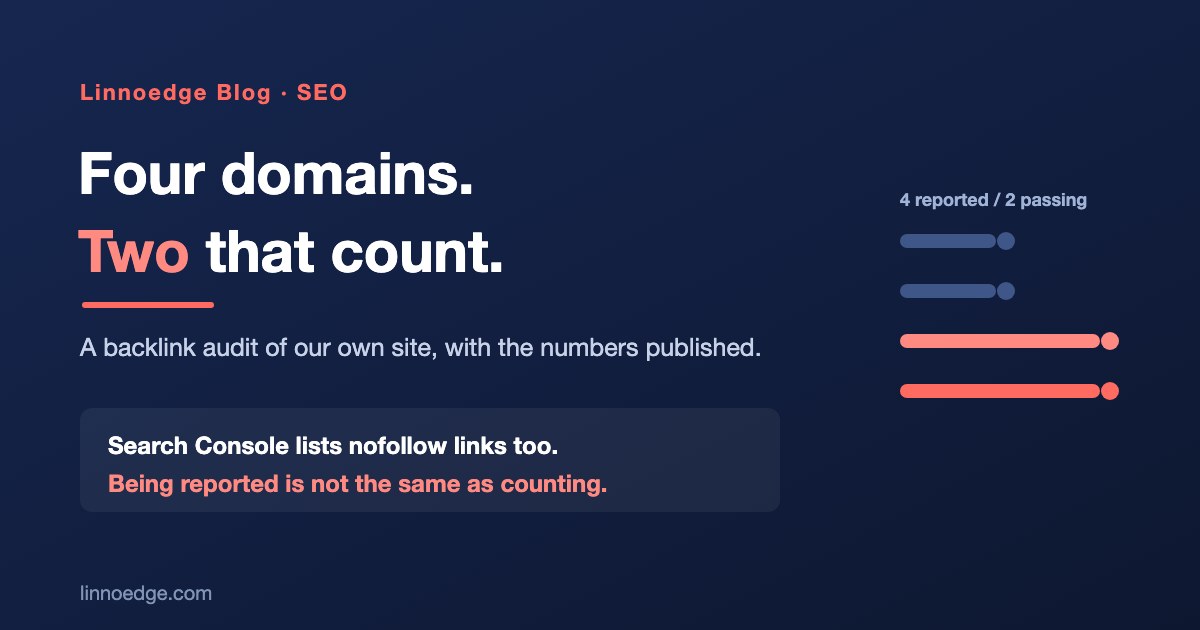
The answer was four domains. Of those four, two pass any ranking value at all.
I am publishing the numbers because the gap between them is the whole story. Most link-building advice is written by people who sell link building, and almost none of it shows you a real audit of a small company’s actual profile.
The method is two steps, and we were skipping the second
The first source is Google Search Console’s “Top linking sites” report. That is Google telling you which domains it has recorded pointing at your site.
The second source is the page itself. Open the profile in a browser, find the anchor tag that points to your own domain, and read its rel attribute.
Search Console’s linking report includes nofollow links. A domain appearing in that report is evidence that Google found the link. It is not evidence that the link does anything for you. If you stop after step one, you will conclude that your directory listings are working, and you will keep registering on more of them.
One practical note: fetching the page with a command-line tool will not do. Most conversion tools strip attributes, and several of these sites sit behind bot protection that returns an interstitial instead of the profile. The attribute has to be read from the live DOM.
What Search Console had
- goodfirms.co: 3 linking pages
- a client site we delivered: 1
- fact-link.com.vn: 1
- twitter.com: 1
As of the 15 August 2026 export, that is everything Search Console has. It is what Google reports, not a census of every link that exists. It is a small number, and I would rather publish it than a large vague one.
What the rel attributes said
GoodFirms, a B2B software directory: nofollow. Twitter: nofollow. Fact-Link, a Vietnamese business directory: no rel restriction, so the link passes. The client site we delivered: rel="noopener noreferrer", which restricts nothing that matters here, so the link passes.
Then I checked profiles that Search Console had not recorded at all, to see whether they were missing or merely invisible.
Crunchbase, where we have a company page: two links to our domain, both rel="nofollow noopener noreferrer". Apple Business Connect: our listing exists, but I could not locate a public page URL, and neither apple.com nor maps.apple.com appears in the report. Clutch, where we had completed a full profile including portfolio entries: absent entirely. Opening it explained why. Our site URL sits in the portfolio as plain text rather than an anchor, and the “Visit Website” button routes through a Clutch redirect. There was never a link there to find.
I also checked the Japanese publishing platform where we post articles regularly. Three outbound links from our posts to our own site, all rel="noopener nofollow". The domain does not appear in the report either.
Two links, and one of them was an accident
Out of every registration, profile and platform: two links that carry weight.
One is the Vietnamese directory. The other is a site our own engineers built for a client, carrying a credit link in the footer. I am leaving the client’s domain out here.
That second link was not part of any link-building effort. Nobody planned it. It is a byproduct of doing the work. It is worth more than every directory profile combined.
What we stopped doing
We had a queue of further directories to register on. We closed it.
The pattern is not specific to us. Anything you can obtain by filling in a form is user-submitted content, and nofollow is exactly the attribute for that, so most sites apply it. There are exceptions: in our own measurements the TechBehemoths and e27 company profiles carried no restriction. You only find out which kind you are dealing with by reading the rel yourself. The same logic runs through paid distribution: links from Japan’s dominant press-release wire are largely nofollow as well, so a paid release buys you reach, not authority.
The free route that used to work here has narrowed too. HARO, the service that connected journalists to expert sources, was folded into Connectively and shut down on 9 December 2024. Featured.com bought the brand in April 2025 and restarted it as a paid product (Prezly’s summary; I could not open Featured.com’s own pricing page, so I am not quoting a figure). A free successor, Source of Sources, is running, and Qwoted covers the paid end.
Meanwhile the technique that practitioners rate highest is the one that cannot be bought at all. In one industry survey, 48.6% of SEO practitioners named digital PR, publishing original data that other writers have to cite, as the most effective method available to them (source).
Update, 5 September 2026. We made one exception to that closed queue. DesignRush activates a profile only if you link back to it, so we agreed on one condition: our link carries rel="sponsored", the attribute Google asks for when a link is given in exchange for a placement. Here it is, marked as such, and counted as reach rather than authority: Listed on DesignRush.
The three we decided to work on
Three things, all of which have the same shape: a link someone chose to give you. There may be more, but these are the three within our reach.
Work you shipped, credited. If you build software or websites for other companies, this was the link that worked best for us. The constraints are real. Ask the client, and never use identical anchor text across many sites, because that reads as manipulation rather than credit.
Answering questions journalists have already asked. This costs nothing but a founder’s attention, and it is the one channel where being a small unusual company is an advantage rather than a handicap.
Publishing numbers nobody else has. This article is an attempt at that. Our own figures were the only dataset available to us that no competitor could republish first. We ran into the same lesson from the other direction when a competitor we had reported on turned out to have closed down: we had put off re-counting data that already looked finished.
The check
We will run the same two-step measurement again in twelve months and publish the result. If the count of value-passing links has not moved past two, the approach described here did not work, and I would rather say so than quietly stop writing about it.
We have written before about why all tests pass but code still breaks in production. A green report with no value flowing behind it is the same mistake in a different domain: the definition of passing has been placed on top of something nobody measured.
FAQ
My domain shows up in Search Console. How can it not be working?
The linking report lists what Google found. It does not filter for whether value flows. nofollow links sit in the same table as the rest, so appearing there tells you the link was discovered, not that it counts. Presence and value have to be checked separately.
Are nofollow links worthless?
For ranking value, nothing flows. People can still click them, but we have not measured referral traffic from our own listings, so I cannot claim they bring enquiries. The accurate statement is not that they are worthless, but that they are not where you spend time if the goal is search.
Should we stop registering on directories entirely?
No. Stop adding them for the reason “it grows our link count”. If prospects genuinely find you on a listing and get in touch, keep it for that. You are only changing the measure from number of links to traffic and conversations.
Want your own numbers measured properly, once?
Linnoedge is a software engineering company in Ho Chi Minh City. We build dedicated teams for system development, and we run our own site measurement exactly the way this article describes. If you want the same done inside your company, talk to us.

Shogo Harada原田 祥吾
CEO · Linnoedge Inc. · LinkedIn↗
Operating IT offshore development and overseas expansion support businesses across two bases: Tokyo and Vietnam. A leader who believes in “Systems over Spirit,” structuring cross-border businesses that often tend to be opaque. Committed to providing “reproducible quality” to organizations and clients rather than relying solely on individual skills.