
In my previous post about working across borders, I explored how success in a new environment depends on having a solid internal compass. Today, I’m seeing a new kind of “border crossing” in our industry: the move from manual coding to AI-augmented development. But there is a trap waiting for us in this new territory. If you don’t know exactly where you are going, a faster engine just helps you get lost more quickly.
The dangerous trap of “it runs”
We’ve all been there. You paste a prompt, the AI generates a block of code, you plug it in, and the terminal shows no errors. It works. Or rather, it runs.
In the age of AI, we are falling into the trap of thinking that “it runs” is the same as “it’s right.” When we prioritize speed over correctness, we aren’t building software; we are just stacking coincidences. An AI can solve a symptom while ignoring the system, giving you a solution that works for ten rows of data but crawls with ten million.
The high price of invisible debt
When we treat AI as the captain rather than the co-pilot, we start accruing “invisible debt” that eventually comes due:
- Epistemic debt: This is the gap between what your code does and what you actually understand. Shipping code you can’t explain is gambling. If a bug appears at 3 AM, you can’t fix it because you didn’t write the logic; you just curated it.
- Architectural rot: AI is an “append-only” thinker. It is great at adding functions but terrible at refactoring them into an elegant system. Without a clear human vision, your codebase quickly becomes a “Frankenstein’s monster” of disconnected snippets.
- The perception gap: You might feel 20% faster, but you are often actually slower. The time you save generating code is frequently lost later while debugging subtle “hallucinations” or fixing security vulnerabilities you didn’t have the technical depth to spot.
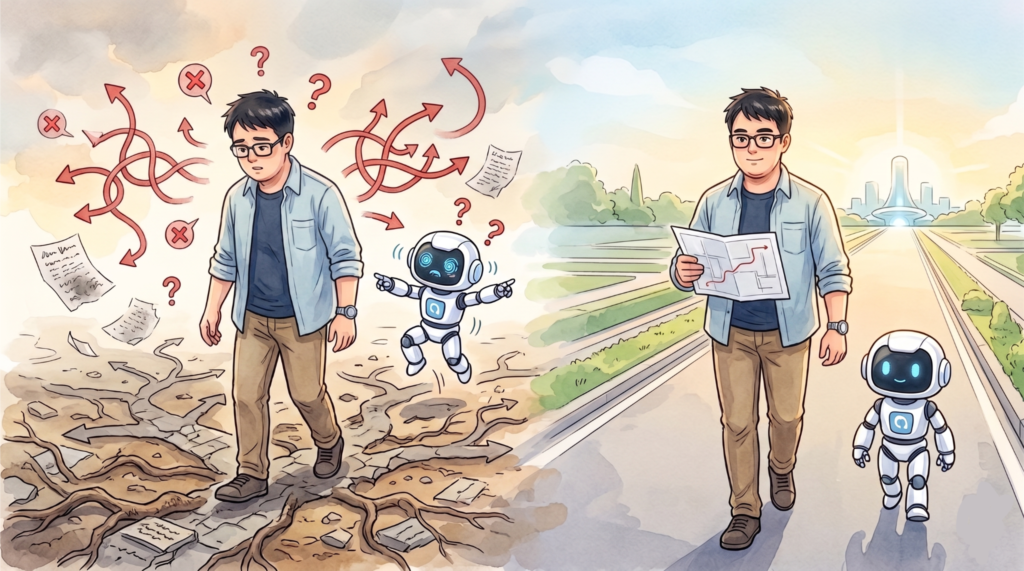
The clear path vs. the random walk
Without technical depth, using AI becomes a random walk. You prompt, get an error, ask for a fix, and repeat. You are moving, but you aren’t heading toward a destination; you are just reacting.
A clear path requires you to be the architect before you are the prompt-engineer. You need to know how the data flows and the security implications of the logic before you hit “generate.” If you can’t draw the map on a napkin, you shouldn’t be asking an AI to drive the car.
Why guardrails matter: Choosing a robust framework
One of the best ways to maintain a “clear path” is to stop reinventing the wheel and start using a robust framework. When you use a framework like PHP Laravel or Ruby on Rails, you are adopting a philosophy that provides the “guardrails” AI often ignores.
These frameworks enforce standardized structures and built-in security, making the “random walk” much harder to fall into. At our core, we are strong in developing software with Laravel and Rails because these foundations allow us to use AI to speed up the “how” without ever losing sight of the “why.”
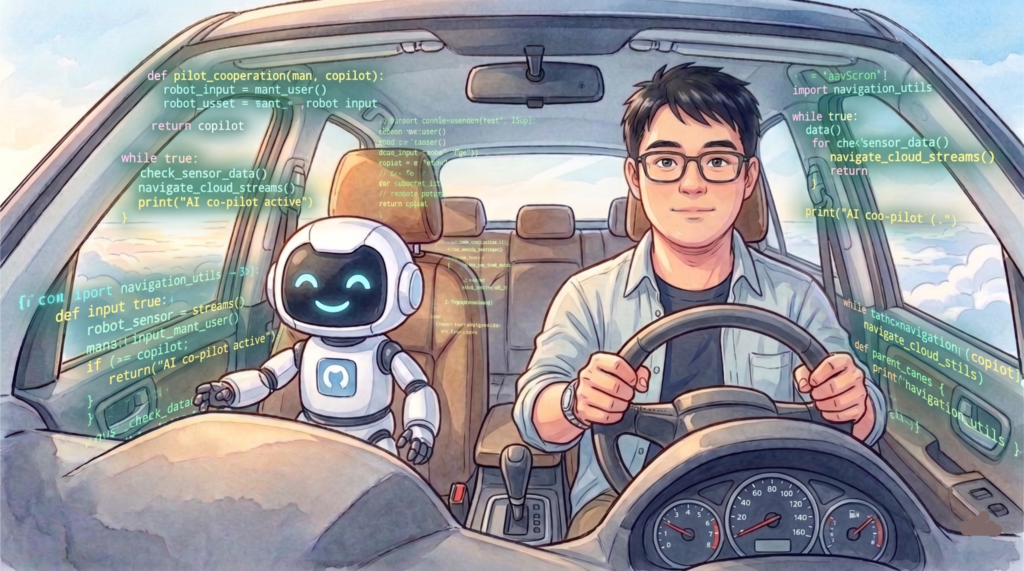
Conclusion: Stay in the captain’s chair
AI is a brilliant co-pilot, but it is a terrible captain. It doesn’t care about your long-term technical debt or the scalability of your business; it only cares about fulfilling the next prompt.
To stay in control, we must reclaim the craft. Use AI to handle the boilerplate, but keep the architecture in your own hands. Choose tools and frameworks that support a clear path, and never settle for “it runs” when you should be aiming for “it’s right.”
Closer to the operational side, see mobile app development. For the consulting frame on this, see our enterprise RAG work.
Working out where AI fits your team?
I run my own company on AI every day — the wins and the misfires included. If you’re deciding what to hand to AI and where people stay in the loop, a free 15-minute call is a good place to start. Not a pitch — just thinking it through together.
Book a 15-minute call →
Dang NguyenDang Nguyen
CTO · Linnoedge Inc. · LinkedIn↗
Tech Leader with 15 yrs in IT. Leading with a ‘what is right, not who’ mindset to deliver exceptional, client-first solutions.