“Can we just add one small thing?”
Anyone who has worked on a software project knows this sentence. It arrives mid-sprint, in a friendly tone, almost always with the word “just.” A button. An extra field. One more filter.
Experience in project management teaches a lesson that sounds backwards at first: scope creep is rarely the client’s fault. Most of the time, it is the team’s. Not because clients are always right, but because they cannot see the cost of a change unless we show it to them.
“Small” requests are almost never small
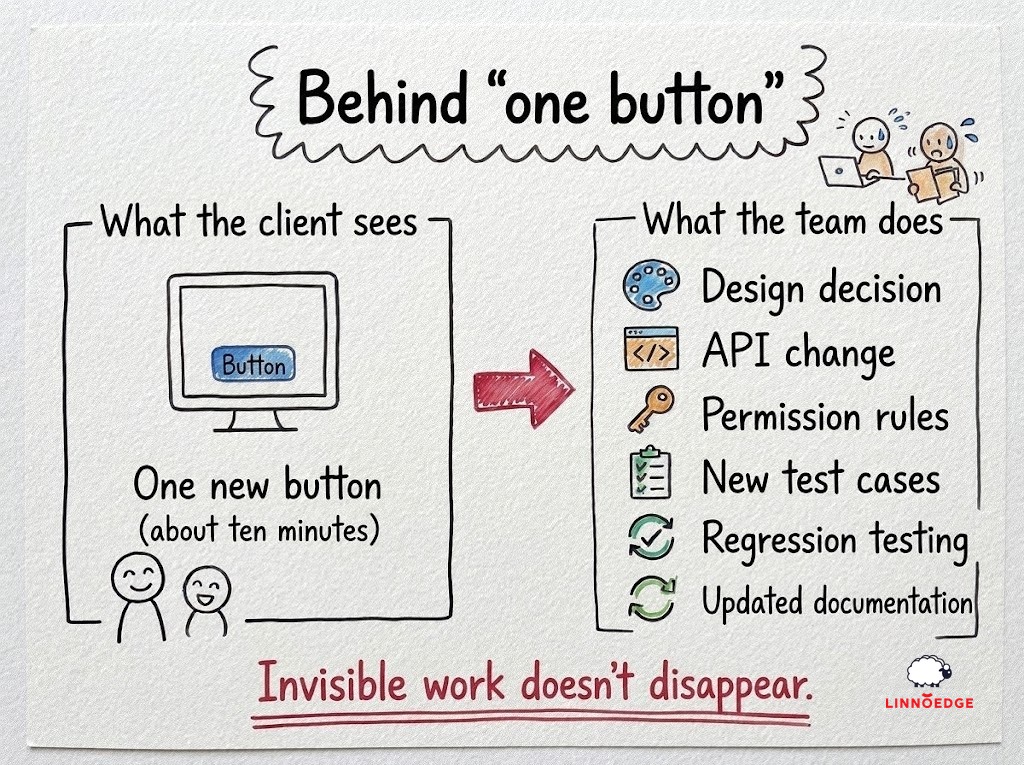
To the client, a new button looks like ten minutes of work. To the team, it can mean a design decision, an API change, permission rules, new test cases, regression testing, and updated documentation.
None of that is visible on screen. If nobody makes it visible, the work does not disappear. It moves into overtime, a skipped test, or a delay that shows up three weeks later with no clear reason.
A process gap, not a people problem
Projects where scope spirals usually follow the same pattern. The client asks. Someone on the team says “OK, we can do it” because it feels helpful. No one writes down the cost. By the time the schedule slips, nobody remembers which “small” change caused it.
Offshore projects make this even easier to fall into. Distance, time zones, and a second language make it tempting to say yes now and explain later. Both sides act in good faith, and both sides end up surprised.
The fix is not saying no more often. It is making sure every yes comes with a price tag both sides can see.
Four habits that keep change healthy
1. Define “done” before work starts
Each feature gets a few lines of acceptance criteria: what the user does, what should happen, and what is out of scope for now. That last line matters most. It is what lets everyone recognize a change when it arrives, instead of arguing later about whether it was “always included.”
2. Answer every change with an impact note within one working day
Not “yes” or “no,” but five or six lines: what changes, estimated effort, schedule impact, risks, and options. One working day is fast enough that the client does not feel blocked, and long enough for a developer to actually look at the code before anyone makes a promise.
3. Offer options, not a refusal
A plain “no” hurts the relationship. A plain “yes” hurts the schedule. Options let the client decide with full information:
- Add it now, and move something else to the next release
- Add it next release, and keep the current plan intact
- Add a simpler version now, and improve it later
4. Keep one shared change log
Every approved change is logged with the date, request, decision, and schedule impact. Not to prove who was right, but so that “Why did the release move by a week?” takes thirty seconds to answer, not a tense meeting.

A real example from our projects
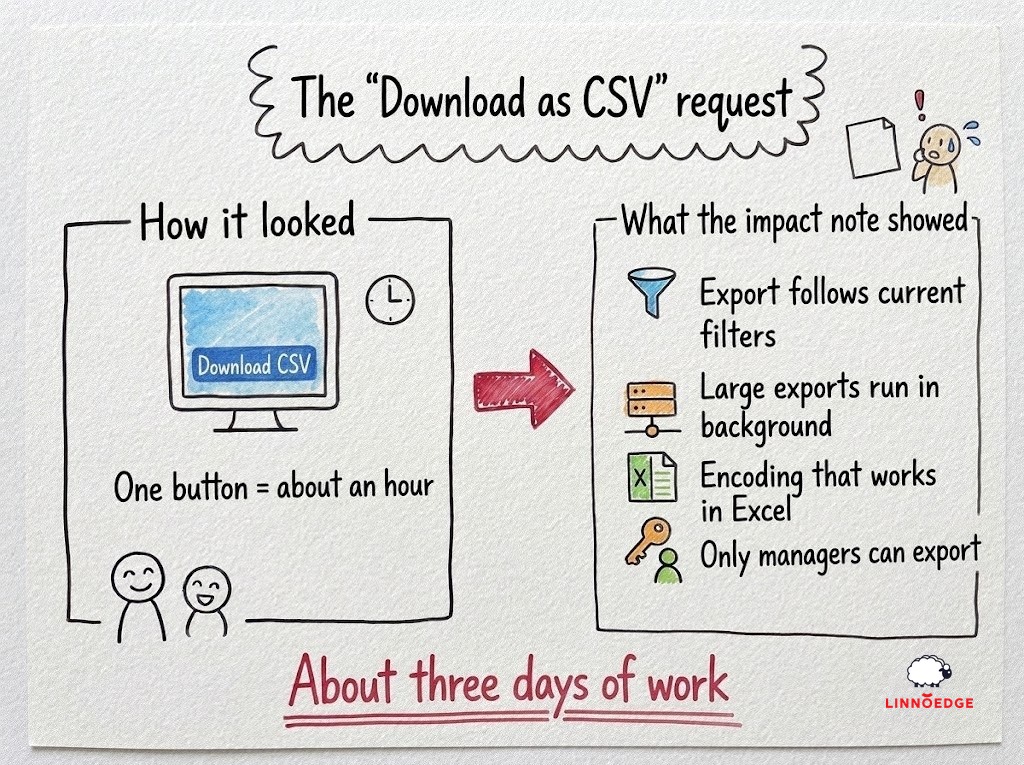
“Can you add a ‘Download as CSV’ button to the order list?” We have received this exact request on more than one project. Each time, it sounded like an hour of work.
The impact note said otherwise. The export had to follow the current filters. Large accounts had tens of thousands of orders, so it had to run in the background. Japanese users would open the file in Excel, so the encoding had to be handled or names would turn into garbled text. And only managers should be able to export customer data.
“One button” turned into about three days. Given the options, clients in this situation often choose a simple export now and the full version next release. Nobody is upset, because nobody was surprised.
What changes
The biggest difference is trust. Clients stop worrying that the team says yes to everything and quietly falls behind. Developers stop absorbing invisible work through overtime. Acceptance testing stops being the moment everyone discovers the project grew by 30 percent. Conversations about change become calm and routine, which is exactly what they should be.
It connects to an idea we have written about before: developers taking ownership of their estimates and progress. An impact note is simply an estimate shared early, before it becomes a delay.
Change is not the enemy of a good project. Unpriced change is.
Frequently Asked Questions
What is scope creep?
Scope creep is when a project’s requirements keep growing during development. Small requests, often introduced with the word “just,” add up to overtime, skipped tests, and delays that show up later. Most of the time, the cause is a team that says yes without showing the cost of the change.
How should a team respond to a small change request?
Not with a plain yes or no. Within one working day, send an impact note: five or six lines covering what changes, estimated effort, schedule impact, risks, and options.
How can you handle change requests without saying no?
Offer options: add it now and move something else to the next release, add it next release and keep the current plan intact, or add a simpler version now and improve it later. Options let the client decide with full information.
Tired of “small” changes turning into big delays?
This is how our project managers and engineers in Ho Chi Minh City handle change every week: clear acceptance criteria, impact notes within one working day, and options instead of surprises. If you are planning a project or struggling with one, let’s talk about what actually matters for it.
Contact Us →
Van TranVan Tran
Project Manager · Linnoedge Inc.
Technical PM with 11 years in web dev. Leading cross-functional teams to deliver secure, scalable, and user-centric web applications.
About Linnoedge: System Development