
Before AI became part of everyday work, I had a pretty simple idea of what it would do for us. If something used to take three hours and AI could help me finish it in thirty minutes, that should mean more free time: more time to rest, take care of personal things, or simply enjoy life outside of work.
The more I use AI, though, the less convinced I am that it works that way.
There is no question that AI makes us faster. Writers can get a first draft together in minutes. Marketers can explore more ideas. Office workers can summarize long documents and put reports together much faster. Developers can use AI to understand code, investigate bugs, or write tests.
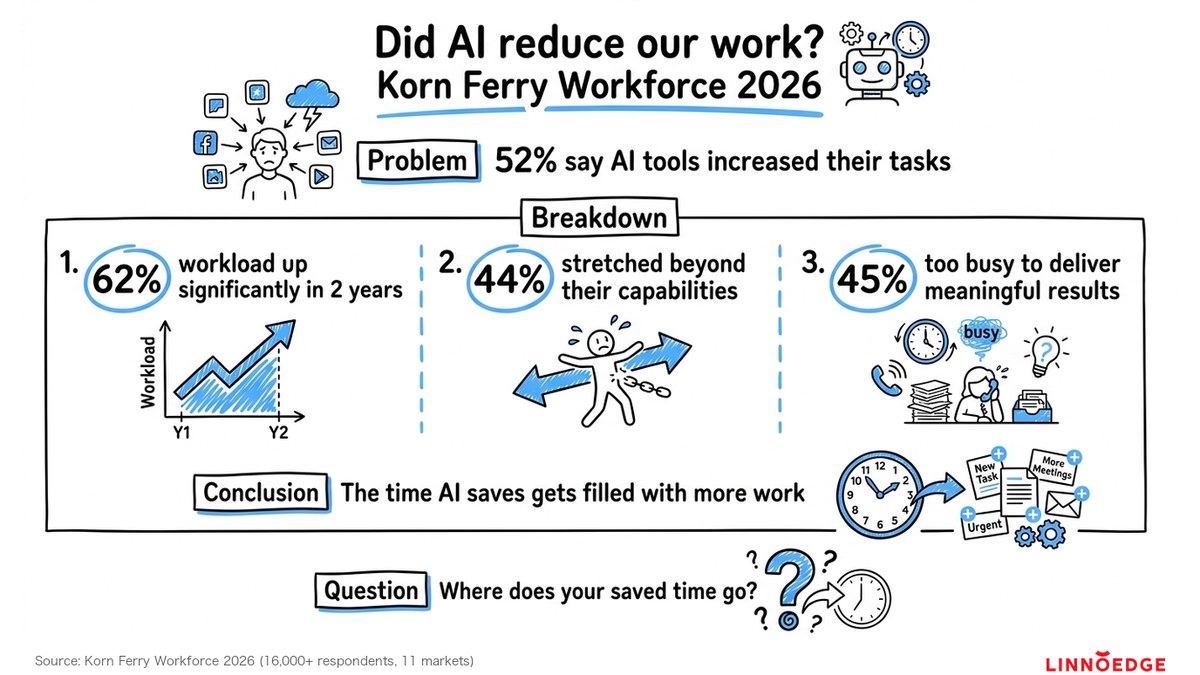
Task by task, we are saving a huge amount of time. But I have started to notice something: the time we save rarely turns into free time. Most of the time, we just fill it with more work.
Getting Things Done Faster Doesn’t Mean Working Less
A few years ago, if something took most of the afternoon, that was probably your afternoon. Now AI might help you finish it in an hour, and suddenly there is room to squeeze something else in.
“Maybe I’ll take care of that other task too.” “Let’s try one more version.” “I have some time, so I might as well look into this.”
Finishing early doesn’t always mean stopping early anymore. It often just means starting the next thing sooner. A report that is already good enough can be analyzed a little further. A piece of content that already works can have five more variations. An idea that might once have stayed in a notebook can become a working prototype before the day is over.
AI has made it incredibly easy to start things. And when starting something becomes easier, we naturally start doing more of it.
Less Manual Work, More Decisions
This is something I notice more and more as I use AI: it can take a lot of work off our hands without necessarily taking much pressure off our minds.
Ask AI a question and, within minutes, you may have several good options in front of you. But now you have a new job: deciding which one is actually best. Did the AI understand what you wanted? Should you refine the prompt? Is the first answer good enough? Should you run it again? Maybe another model would do a better job?
AI is extremely good at creating options. But someone still has to judge those options. So instead of being busy doing everything ourselves, we can end up busy reviewing, comparing, correcting, and deciding what to do with everything AI gives us. Our colleagues have also explored why adding AI tools alone does not redesign a workflow.

We’re Doing More Things at Once
AI also makes it much easier to keep several things moving at the same time.
While AI works on one task, I can start another. While I’m waiting for that one, I can move on to something else. Then the results start coming back, and suddenly I’m jumping between them: reading, reviewing, giving feedback, and deciding what happens next.
It can feel incredibly productive. It can also feel like having too many browser tabs open in your head.
Nothing is completely finished. Several things are waiting for your attention, and each one needs some kind of decision before it can move forward.
There are days when I get a surprising amount done and still end the day feeling more tired than usual. It’s not always because the work itself was difficult. Sometimes it’s simply the mental cost of constantly switching contexts and making small decisions all day long. A colleague’s review of organizing tasks with Getting Things Done offers one way to ease that load: capture everything floating in your head in a trusted system, so your mind doesn’t have to hold it all at once.
“I Still Have Tokens Left…”
AI subscriptions have also created a funny new habit. When tokens, credits, or usage limits are about to reset, it’s easy to think: “I still have plenty left. I might as well use them.”
And suddenly we’re looking for more things to do. Maybe we analyze something that isn’t particularly urgent, generate another version, ask for another review, or run the same task through a different model just to see what happens.
There’s nothing wrong with experimenting. It’s often how we discover better tools and better ways of working. But there’s a strange irony in buying AI to reduce our workload, then creating extra work for ourselves because we don’t want our AI allowance to go to waste.
New AI Tools Give Us Even More to Keep Up With
Then there’s the pace at which AI itself is changing. There always seems to be a new model, a new tool, or a new feature worth checking out. So alongside our actual jobs, many of us have picked up another one: keeping up with AI.
We read announcements, watch demos, test new tools, compare models, learn new prompting techniques, and rethink our workflows. Just when we feel like we’ve figured things out, something new comes along.
And in fields that are being reshaped by AI, ignoring all of this can feel risky. What if everyone else finds a tool that makes them twice as fast? What if the workflow I’m using today is already outdated?
So some of the time AI saves us ends up going straight back into learning how to use more AI. In another Linnoedge article, we looked at why chasing every new AI tool can actually stall AI adoption.

Productivity Goes Up. Free Time Doesn’t.
This is the part I find most interesting. Maybe we used to get five things done in a day, and now AI helps us get eight or ten done. That sounds great. But once we know ten is possible, it doesn’t take long for ten to become the new normal.
Our capacity goes up, and our expectations tend to rise with it. Sometimes those expectations come from work. Sometimes they come from ourselves. Either way, the time we saved disappears surprisingly quickly.
It seems I’m not the only one noticing this. Researchers at UC Berkeley’s Haas School of Business studied how employees actually worked with AI tools and reported in Harvard Business Review that AI didn’t reduce their work. It intensified it: people worked at a faster pace, took on a broader range of tasks, and let work stretch into more hours of the day, often without anyone asking them to.
When we finish something two hours earlier than expected, our first thought is often, “What else can I get done?” We don’t often think, “Great. I just got two hours of my life back.”
Use AI Well and Know When Enough Is Enough
AI can help us work faster, but that doesn’t mean every minute we save has to be filled with another task. Using AI well should also mean knowing when enough is enough.
Some of that extra time can go to family, friends, hobbies, exercise, or simply doing nothing for a while. AI should make work easier and more manageable, not give us another reason to keep working just because we can.
When a whole team starts using AI, these lines are easier to hold if you decide together where AI fits into the workflow, rather than leaving each person to find their own limit. That is why our AI training for teams includes workflow design, not just how to use the tools.
In the end, becoming more efficient shouldn’t only be about getting more done. It should also give us more time for everything outside of work, and hopefully, a better life because of it.


Truong Bien
Senior Software Engineer · Linnoedge Inc. · LinkedIn↗
Fullstack Software Engineer passionate about coding and technology. In the fast-changing AI era, I focus on strengthening core thinking and technical foundations instead of chasing every trend.