Looking back, time really flies! In the blink of an eye, I’ve already been the IT Director here for exactly 6 months. From taking my very first steps in the role, it has been a crazy journey of figuring things out, making mistakes and fixing them, and feeling totally clueless about so many new things.
It definitely wasn’t easy! But through all of that, my biggest lifesaver wasn’t some expensive training course. It was actually one amazing book that helped me so much: Getting Things Done (GTD) by David Allen
The Beginning: The “Off-target” Advice
Before officially taking the job, I was quite anxious because I had no practical experience in this challenging IT Director role (which involves acting as a Communicator, Coordinator, and Tester simultaneously). I asked my boss what kind of book I should read to prepare and get a better overview before hopping into the job.
I was certain I would receive a recommendation for some grand, theoretical manual, but my boss simply replied: ‘Find and read the book Getting Things Done.’
A bit surprised, I was also very curious. My company, Linnoedge, also has a meaningful policy to encourage everyone to read books, so I could easily take advantage of this opportunity to get the book for myself, hoping it would be my helpful handbook.
The Harsh Reality: The Obsession of a “Multi-hat Wearer”
Despite being mentally prepared, the first few days were a real shock. Taking on multiple roles at once made me the “hotspot” for all information flows within the project.
Imagine my typical workday: In the morning, I focus on reviewing, reporting, and creating to-do lists (Coordinator role); then I move on to testing, finding bugs, and logging them on the Plane system (Tester role); in the afternoon, I work on SEO Content, editing articles, and researching Google Search Console…
Constantly having to “change hats” (context-switching) caused my brain to go on strike. “Surprise tasks” kept interrupting, leaving me overwhelmed. By the end of the day, looking back at the unfinished morning to-do list while my mind was exhausted, I fell into a state of panic and carried that stress home with me.
Getting Things Done (GTD) – 5 Steps to Tame the Chaos
While struggling to find a way to control the massive workload, I began to read and ponder the GTD book. From the very first pages, author David Allen gave me a “cold splash of water” that woke me up with the classic quote: “Your mind is for having ideas, not holding them.”
I realized my stress came from forcing my brain to act as a “hard drive” to store too much cluttered information. Applying GTD’s 5-step workflow management system, I rebuilt my own “operating system”:
1. Capture – Mind Sweep
The first principle is to “capture” everything floating in your head and lock it into a trusted system. I created a task management system on Google Sheets.
Whenever a request hits—a test flow improvement idea, a developer’s question on Google Chat, or a hesitation about an unclear spec that needs re-asking—instead of telling myself “remember to handle this this afternoon,” I throw them all into this spreadsheet.
“Emptying the mind” makes my brain feel light. I no longer waste energy trying to remember if I’m forgetting something, allowing me to focus 100% of my thinking capacity on translation or handling current bugs.
2. Clarify & Organize – The Task Classification Matrix
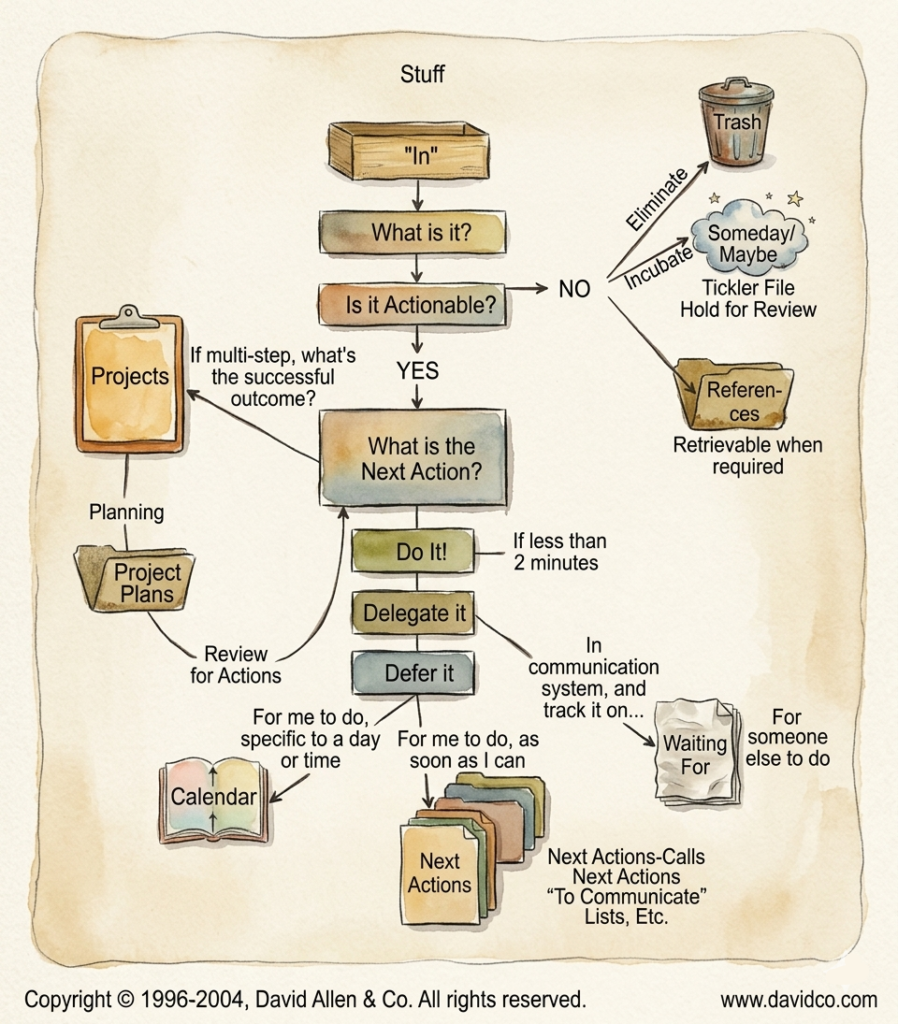
At fixed times during the day, I open the Inbox and start asking questions for each item: “Is this actionable?”. The book provides a sharp Decision Tree that helps me avoid getting confused.
- If NO action is needed, I handle it in three ways:
- Trash: Completely ignore unnecessary information.
- Reference: For example, Spec documents sent by clients are saved immediately to Confluence for later lookup.
- Someday/Maybe: A feature suggested by a client but not for this Phase is thrown into the Backlog.
- If action IS needed, I immediately apply:
- The Golden 2-Minute Rule: If a task (like a quick chat translation or granting Google Drive access) takes less than 2 minutes -> Do it immediately.
- Delegate: Hand this task to someone else if possible (very useful for the Coordinator role).
- Defer: Schedule it for a specific time if it takes more than 2 minutes and I must do it myself.
3. Determine the “Next Action” – The Skill of Slicing the “Work Elephant”
Previously, I used to write very “macro” phrases in my to-do list like: “Complete Phase 1 Quality Control” or “Finish design documents.” The author calls these “Projects,” not “Actions.” Writing like that is the fastest way to make yourself hesitate because it’s too massive.
GTD taught me how to identify the “Next Action”—the most specific physical action needed. I changed my writing style to: “List 20 actions needed for the article to index on Google” or “15-minute meeting with the boss at 2 PM to align.” By breaking down expectations into immediate actions, the boulder of pressure is crushed, helping me maintain momentum without procrastination.
4. Choose Tasks by Energy (Context & Energy) – The Secret of Multitasking
When you have to wear many hats (Comtor, Coordinator, Tester, Content…) at once, choosing which task to do next is crucial. GTD guides selection based on Context and Energy.
At 3 PM, when my brain starts to get weary after stressful meetings, I won’t choose to do a system logic analysis task. Instead, I pick lower-energy tasks from the “Next Action” list: retest some fixed UI bugs or reviewing translation document formats. Thanks to this, I continue to create value without “burning out” my engine.
5. Weekly Review – The Unmissable Survival Ritual
David Allen asserts: “Your system will collapse if it is not maintained.” No matter how well you set it up, after a week of running a project, everything will start to get messy again.
Therefore, I created an inviolable “ritual” for myself: spend 30 minutes every Friday evening doing a Weekly Review. I clean up the Spreadsheet, update project progress, delete unnecessary tasks, and set up the “Next Action” framework for the following week. The feeling of closing the laptop on Friday afternoon with a clean mind and a clear plan for the new week is truly a privilege that the GTD system provides.

Closing Remarks: Not Just Work, but the Art of Mastering Life
After 6 months of being “tested by fire,” though not yet perfect and still having many shortcomings, I no longer panic amidst the task matrix. I react faster, remain calmer while coordinating, and most importantly, stay mentally steady under pressure.
But the greatest value I realized is: GTD is not just for managers or those with a massive volume of tasks.
Any of us, from the Dev drowning in bugs, the Comtor struggling with specs, to anyone confused by a long to-do list in daily life (planning a trip, grocery shopping, picking up kids, cooking, going to the bank…) can apply it.
The GTD system helps us clear our minds and reorganize everything so that each workday is no longer a survival battle. And most importantly, when we close our computers, we can fully devote time to ourselves without being haunted by unfinished business.
If you are also feeling lost in the daily mess of work, don’t hesitate to take advantage of our company’s wonderful book purchase policy to get “Getting Things Done.” It truly is a worthy investment for your peace of mind!
Is your IT project falling into chaos, missing deadlines, and suffering from broken communication between teams? Don’t let lack of organization burn your budget and time. At Linnoedge, we don’t just code; we operate projects using the most optimal management processes so that every task stays on track.
👉 Contact Linnoedge now and let us help you standardize and untangle your project today!
Adjacent thread: AI integration consulting. Closer to the operational side, see OfficeBrain.
Related reading
A 15-minute free conversation
If a “faces visible” model of offshore development sounds interesting, I run a fifteen-minute conversation. It isn’t a comparison-table conversation — it’s working out together what actually matters for your specific project.
Book a 15-minute call →
Chau PhanChau Phan
PM / IT-Director · Linnoedge Inc. · LinkedIn↗
Soft girl in love with software. Rookie IT Coordinator turning hard-learned lessons into simple tips to make work accessible & enjoyable.