— Why Letting Go of Your Ultimate Weapon, “Japanese Common Sense,” Actually Increases Your Survival Rate —
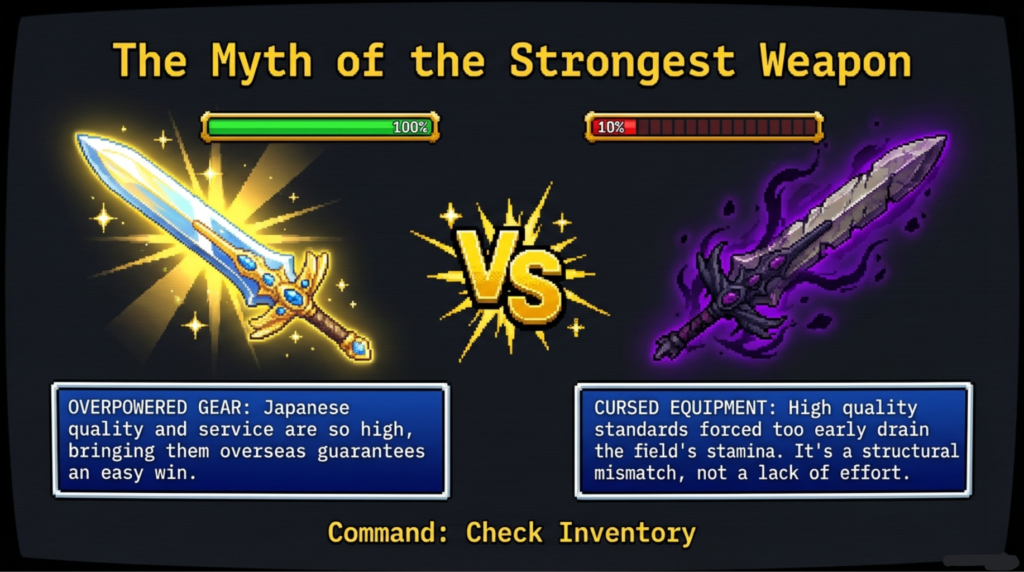
“Japanese services and products are of such high quality that if we take them overseas, we’re bound to win.“
I imagine quite a few people think this way. But today, I want to talk about why that mindset might actually be a dangerous trap.
Hello, I’m Shogo Harada, CEO of Linnoedge.
Today, I’d like to write a bit about Japanese companies expanding into Vietnam.
There are plenty of impressive articles out there claiming to hold the “Secrets to Success in Vietnam!” Honestly, though, many of them feel a bit blurry—like they were written based solely on an occasional inspection tour and a few drinking parties with local staff. It always left me feeling a bit frustrated.
I’ve been on the ground in Vietnam for 15 years. While running my core system development business, I also partnered to run two bars. We eventually sold them, but it was so exhausting and gritty that a glamorous word like “buyout” doesn’t do it justice (laughs).
Because of this, I have absolutely no intention of looking down on or “analyzing” companies that had to withdraw from the market. I know they fought hard until the very bitter end.
However, precisely because of that experience, I firmly believe that many “game overs” could have been prevented if companies simply hadn’t chosen the wrong “starter equipment.”
The “JOY” Phenomenon: A Bug Between the Frontline and HQ
There is a certain slang acronym used self-deprecatingly among Japanese expat presidents running local subsidiaries in Vietnam.
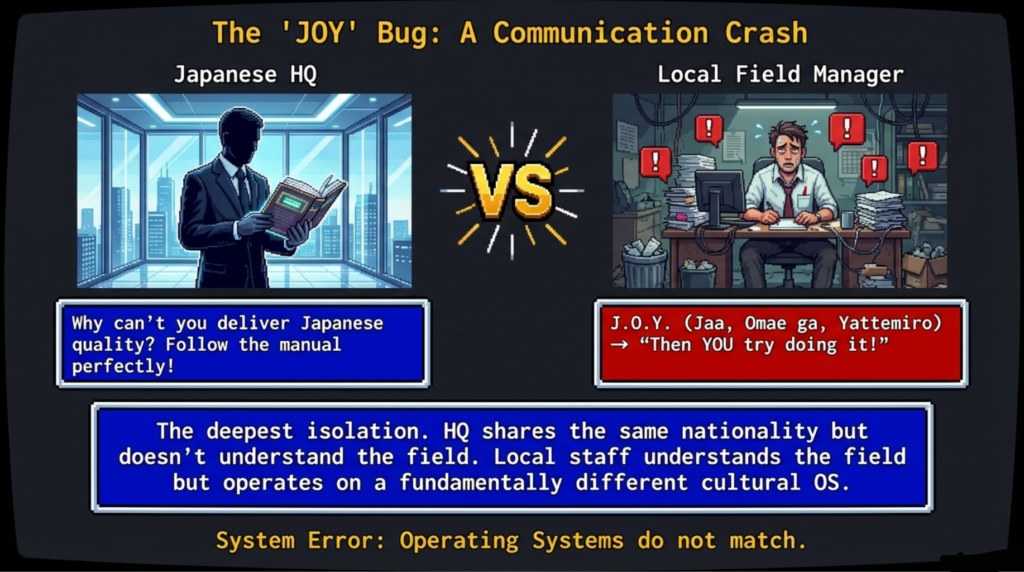
It’s “JOY.” It stands for Jaa, Omae-ga, Yattemiro (Well then, YOU try doing it!).
This is the phrase that gets stuck in their throats when headquarters in Japan sends down instructions completely disconnected from the reality on the ground—things like, “Why can’t you deliver Japanese quality?” or “Stick to the manual more strictly.” Given their position, it’s a phrase they can “absolutely never say.”
Since they can’t argue back directly, when these presidents get together, they just laugh it off: “Yeah, it was another JOY day today…” It sounds funny, but it really isn’t.
The most exhausting part of this is the profound despair of realizing that your supposed biggest allies—your fellow Japanese at HQ—understand the frontline the least.
Ironically, the local Vietnamese staff sweating alongside you every day understand the situation much better. Yet, because you operate on a fundamentally different cultural “OS” (Operating System), there remains a deep loneliness born from the inability to completely understand one another at the root level.
As a result, the only people who can 100% share the very real pain of being handed an “over-specced, ultimate weapon (impossibly high quality standards)” that nobody on the ground can actually swing, are the other Japanese expat presidents forced to play the same impossible game.
Of course, I know the people at HQ aren’t being malicious. They have their own “justice,” like “We have to protect the standards we built in Japan” or “We need to be able to explain this to the shareholders.”
Both sides are working earnestly for the sake of the company. Yet, because of the distance and cultural walls, the “ultimate weapon” becomes a “cursed item” that only drains the stamina and mental health of the frontline team.
When Japanese companies fail in Vietnam, it’s rarely because the core strategy was wrong. I feel that in an overwhelming number of cases, the frontline was simply exhausted by this “structural bug.”
When the “Ultimate Weapon” Fails on the Local Field
Let’s look at Yoshinoya, which entered Vietnam in 2014, withdrew, and then tried again in 2020.
A commonly cited reason for their initial struggle was “narrowing the menu strictly to beef bowls.”
In Vietnam, there isn’t really a culture of eating out alone for a quick meal. Dining out is fundamentally a social activity done with family or friends. A table where “only beef bowls” are served feels highly unnatural given the local culture.
The frontline team wasn’t slacking off. It was a structural mismatch caused by importing the highly polished, “ultimate weapon” of “Beef Bowl Only” straight from Japan.
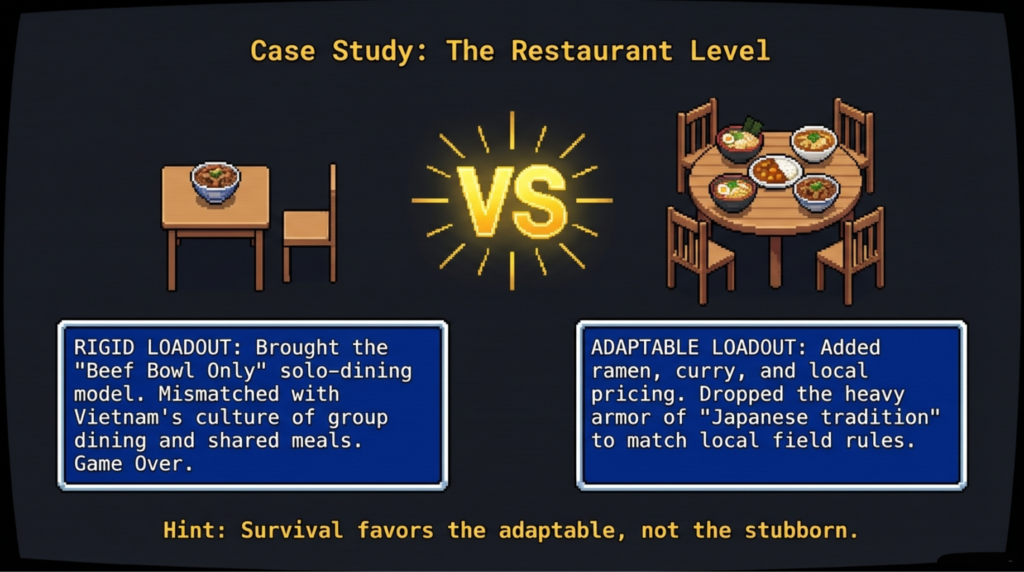
On the other hand, Sukiya adapted by offering ramen and curry alongside beef bowls, making it easier for local youth to drop in. Marugame Udon took a strategy of keeping their price bracket accessible to locals while gradually increasing the quality.
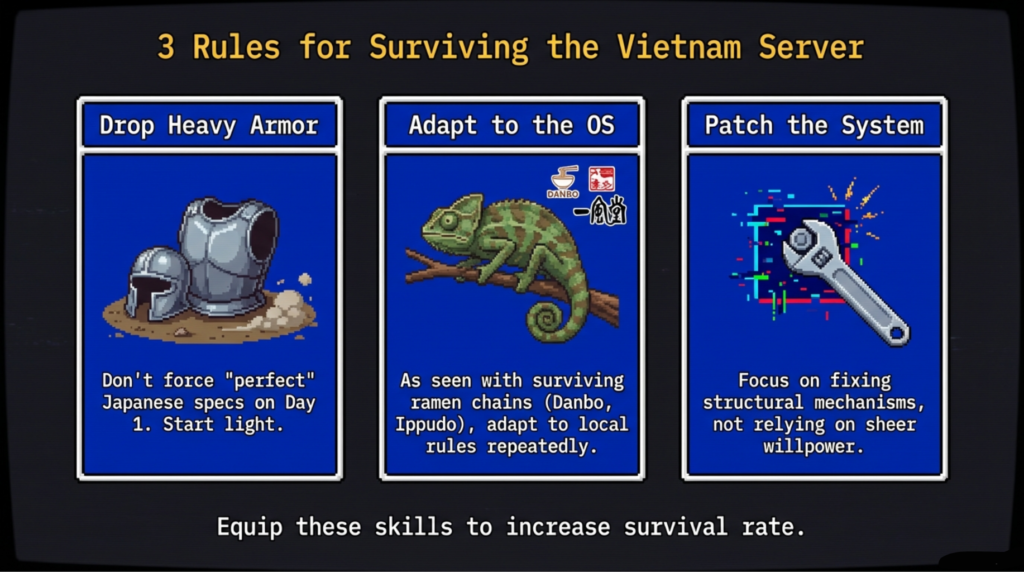
Instead of clinging to the heavy armor of “Japanese High Quality,” possessing the agility to let it go and equip “lighter gear” suited to local sensibilities actually yields a higher win rate.
Now, you might worry, “Are you saying we should throw away our Japanese strengths and just copy local companies? We can’t win a price war doing that.”
I’m not saying you should throw away your strengths forever. This is simply an issue of “deployment order.”
First, you must get down in the dirt and build a foundation tailored to the local perspective, ensuring your local team can function smoothly. Only after that foundation is set should you mount the heavy weaponry of “Japanese High Quality.”
It’s not that Japanese strengths don’t work. It’s that forcing the frontline to swing the “ultimate weapon” during the initial phase—when their legs aren’t even steady yet—crushes them.
In short, trying to force the frontline to adapt to “the Japanese way” right off the bat creates impossible friction. The proper theory is “Build the local foundation first, then add the Japanese strengths.” Many companies simply reverse this procedure.
The product isn’t bad. The frontline isn’t lazy. It’s just an “implementation order bug.”
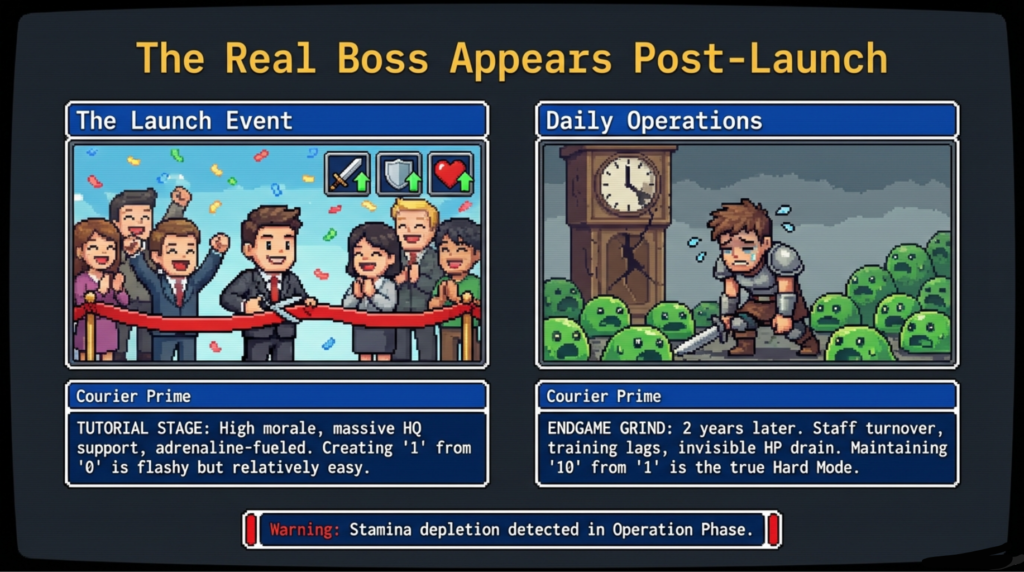
The Real “Hidden Boss” Appears After Expansion
You might be thinking, “Why is a system development guy talking about restaurants?”
Actually, while our company’s main business is system development, we are seeing a massive increase in clients who are shifting their perspective of Vietnam from just a “factory” (offshore development) to a “market.”
Consequently, we have evolved to include an “Expansion Support Unit,” handling everything from company establishment and visa acquisition to local promotion and market creation, alongside our IT services.
Having seen the backstage of various industries, from F&B to IT, I can say that if you step back, they are both just different forms of “manufacturing” (Monozukuri).
The ultimate condition for clearing the game—in both food and IT—is exactly the same: “Exceed the customer’s imagination and create satisfaction.”
Therefore, whether it’s a visible beef bowl or invisible source code, the structural bugs occurring behind the scenes are strikingly identical.
And what truly wears you down is the “normal operations phase” that comes after the glamorous event of the initial expansion is over.
At first, everyone is highly motivated, and there is strong backing from HQ. But one or two years in, as everyday reality sets in, local staff turnover happens, training falls behind, and even though the frontline isn’t cutting corners, their stamina is slowly, steadily drained with every step.
Maintaining a “1 at a 10” is a much harder game mode than creating a “1 from a 0.” Incidents don’t happen in neatly arranged conference rooms; they always happen out in the gritty field.
Adaptability Over Perfection from Day One
Five or six years ago, the ramen industry in Vietnam was in a chaotic state of constant openings and closures. But today, brands like Danbo and Ippudo have firmly put down roots and stabilized. (Tonkotsu broth is remarkably strong overseas, by the way!)
I believe they survived not because they challenged the market in a perfect state from day one, but because, despite facing near-annihilation multiple times, they continuously changed their tactics to adapt to the local rules.
A “wonderful Japanese product” and a “product that can survive locally” are, cruelly, two very different things. The one that survives isn’t the strongest; it’s the one that can adapt to change.
Finally: Before You Hold Your Head Asking “Why Isn’t This Working?”, Let’s Have a Strategy Meeting
Histories of similar “game overs” are repeating themselves right at this very moment.
Having been in the systems industry for a long time, I am obsessed with “finding and fixing fundamental structural bugs (systems), rather than relying on spirit and guts.”
Even so, I have failed countless times on the ground in Vietnam. Even as a systems guy who believes that “putting the right mechanisms in place solves everything,” I’ve smashed into unexpected walls time and time again in this chaotic environment.
If you are a business leader or executive currently pushing for expansion or offshore development in Vietnam, and you find yourself holding your head wondering, “Why aren’t things clicking with the local team?” or “Is our frontline management just weak?”, I urge you to shift your perspective for a moment.
It is rarely a lack of frontline skill or a strategic mistake. It is almost always a simple “structural bug.” Doing business in a foreign country is naturally an environment where it’s easy to start running with the initial settings slightly off.
Just reframing it as, “Ah, it’s not anyone’s fault; it’s just a structural bug,” will help you see your next move.
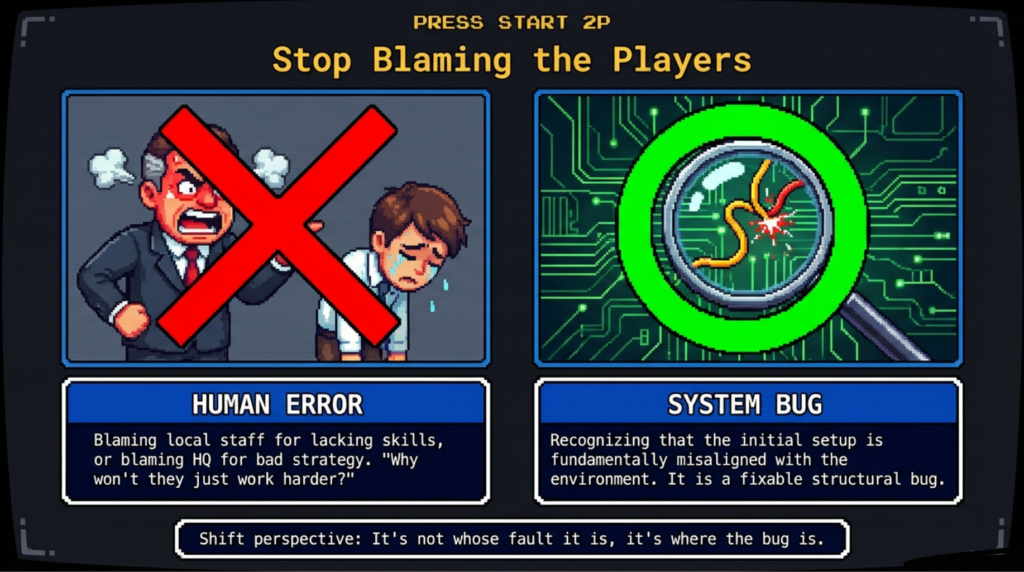
I firmly believe that the hints for beating this game are packed into the gritty, real-world “error logs” (failure stories) scattered across the frontline, rather than in neatly packaged consulting proposals.
So, before that frustration builds up, why not have a quick chat with me?
I am particularly eager to speak with “executives and business leaders” who are making decisions in Japan and facing these walls on the ground. (And of course, I am always looking to connect with fellow entrepreneurial comrades fighting on the front lines in Vietnam!)
The reason I offer these sessions is simple: flat, honest information exchange is the most beneficial thing for both of our businesses.
In exchange for sharing my “raw error logs from the frontline,” hearing about the real-world primary challenges you are facing significantly sharpens our own market resolution. Engaging in dialogue with people who are seriously confronting their businesses is the greatest stimulus for me.
Whether you want to “use Harada’s frontline knowledge as a hint for your business strategy” or simply “use me as a sounding board for your next move,” please feel free to drop in for a casual strategy meeting.
Let’s trade frontline notes — a 15-minute strategy session
Flat information exchange is what actually moves both our businesses. Not a sales pitch — think of it as a sounding board. I’ll share my frontline error logs; you bring the real challenges you’re facing.
Book a 15-minute session →(Feel free to use me as a sounding board—or your personal save point!)
Related reading
- What software development in Vietnam actually costs in 2026
- Why I stopped comparing Vietnam, India & the Philippines
Curious how we actually run projects? Start with our services overview.

Shogo Harada原田 祥吾
CEO · Linnoedge Inc. · LinkedIn↗
Operating IT offshore development and overseas expansion support businesses across two bases: Tokyo and Vietnam. A leader who believes in “Systems over Spirit,” structuring cross-border businesses that often tend to be opaque. Committed to providing “reproducible quality” to organizations and clients rather than relying solely on individual skills.
Closer to the operational side, see our Vietnam team.
For how we run this as an offshore team, see a long-term offshore engagement that goes past staff augmentation.