
“We held an information session to promote the use of AI within the company and distributed accounts. Initially, there was a lot of excitement, but after a few months, no one was using it anymore…”
Recently, many companies have been expressing similar sentiments.
AI, which was introduced with much fanfare, is not being utilized as expected, and an atmosphere of “it’s just too difficult” begins to permeate the workplace. However, we should not conclude this as a “failure.” This phenomenon is a path we have traversed many times in the evolution of technology.
The initial enthusiasm after implementation cooling off and the usage rate plummeting is not unique to AI.
History repeats itself: The enthusiasm of the 1980s and the unchanged Reality
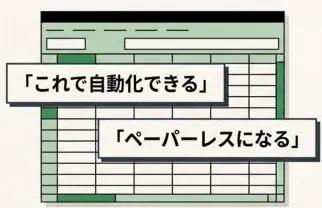
Think back to the excitement surrounding the introduction of spreadsheet software like Lotus 1-2-3 and Excel from the 1980s to 90s. “This will change our work,” “We can automate,” “We’ll go paperless,” everyone envisioned a rosy future.
Every time a new tool emerges, we dream of “automation” and “efficiency.”
But what was the reality? While the tools were indeed adopted, the work itself did not change immediately. Offices were still piled high with paper, manual tasks persisted, and the number of meetings did not decrease. Although things became more convenient, fundamental transformation did not occur.

Even with the introduction of tools, traditional business processes like paper and manual work remained deeply entrenched.
Why did transformation not occur? Because the tools were “outside” the processes
The reason is very simple. The tools were “outside” the business processes. People opened the spreadsheet software, thought through and entered formulas, and made judgments based on the results. The tools evolved, but the way we conducted work—the “structure” of the business itself—did not change.

The tools remained merely auxiliary, with humans still at the center of the business.
True change began with “Redesigning business processes”
Eventually, companies began to realize that merely using the tools effectively was not the goal. What was important was to redesign the business itself as a system.
From here, specialized systems for specific tasks, such as sales management systems, accounting systems, and inventory management systems, began to proliferate. The advent of the cloud and the spread of SaaS made this trend definitive. Instead of calculating by hand in Excel, data was input into accounting SaaS. This centralized the data, and workflows like approvals became fixed and automated. People were freed from calculations, and business began to operate not “above” the tools, but “within” the systems. It was here that true business transformation finally occurred.
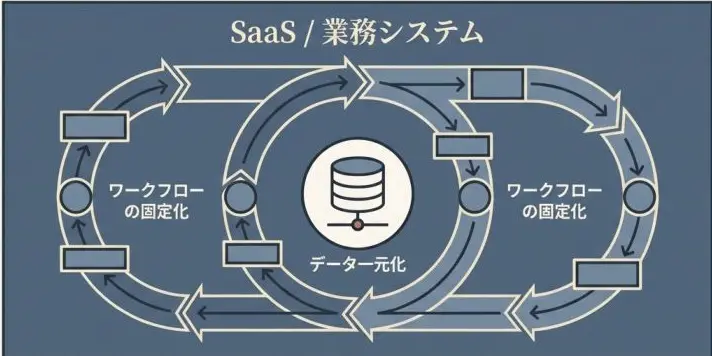
With the spread of SaaS, data centralization and workflow fixation progressed, integrating business into systems.
And Now, Modern AI — History Repeats Again
Now, let’s turn our attention to the current generative AI boom. Many companies are adopting ChatGPT and are hopeful about its potential. However, after a while, they hit a wall of “it’s not being used as much as expected.” This is not a coincidence; the structure is the same as in the past.
AI is again placed “outside.” People open AI on a separate screen, think of prompts, and then copy the results back to their original tasks. This is strikingly similar to how early spreadsheet software was used. Recently, “AI agents” that automate workflows have also gained attention, but the same wall exists here as well.
Agents can execute tasks, but they cannot design business processes.
What to automate and where to leave human judgment. Which data to use as a reference and where to place responsibility. These are not issues of tool functionality, but rather issues of “designing” the business.
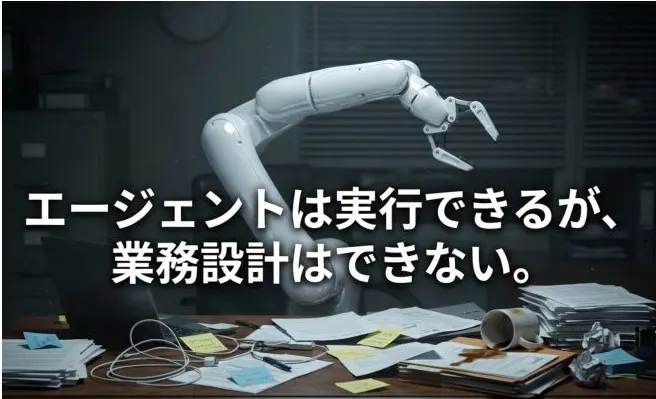
Powerful tools cannot demonstrate their true value without a foundation of business design.
Without that design, the time AI saves can simply fill up with more work. One of our engineers describes this in AI Saves Time, So Why Are We Still So Busy?
To the next stage: The era of “Business integrated with AI”
The utilization of AI has not yet entered its main phase. Just as we evolved from an era of using tools to an era of business systems, AI will also transition to the next stage. This will not be an era of “using AI,” but rather an era of “business integrated with AI.”
- When numbers are input, AI automatically generates analysis reports in the background.
- When conversing with customers, records are automatically generated, and key points are summarized.
- After a meeting, participants receive shared minutes, decisions, and next actions.
In this way, AI operates naturally within business processes without the need to consciously “open” it. Only by designing to this extent will AI truly become a force in business.

The future we should aim for is one where AI is seamlessly integrated into business processes.
Conclusion: The question should be “How to redesign business” not “Which AI to use”
If you feel that AI implementation in your company is not going well, it is not a failure.
It is a sign that the redesign of business has not yet begun, indicating the next step.
History repeats itself, but each time, tools have penetrated deeper into the workings of business. This time is no different. What we should truly be asking now is not “which AI to use.”
How far can we redesign our business with the premise of AI’s existence?
That is where the true utilization of AI begins.
👉 Discover how we turn AI ideas into production-ready solutions in our AI development services and case studies.
Check our related service: AI integration consulting by Linnoedge
We cover related ground in how we kept internal documents AI-searchable without leaking permissions. Adjacent thread: more here.
A 15-minute free conversation
If a “faces visible” model of offshore development sounds interesting, I run a fifteen-minute conversation. It isn’t a comparison-table conversation — it’s working out together what actually matters for your specific project.
Book a 15-minute call →
Shin Uchida内田 伸
COO / AI Consultant / System Development Producer · Linnoedge Inc.
Shin has over 35 years of experience in the IT industry. He began his career in medical systems and later worked on large-scale system development projects for major corporations. Today, he produces business design and system development initiatives that integrate AI into practical operations.