The packing list to maximize the results of your business inspection
Hello. I’m Shogo Harada, CEO of Linnoedge.
In my previous article, we discussed “7 Trust-Building Phrases for Vietnam Inspections.” This time, we’re diving into the more practical side of things: your on-the-ground essentials.
While people often say, “As long as you have your passport and money, you’ll manage,” an overseas business trip requires specific items if you want to maintain your peak performance. After 15 years in Vietnam – and plenty of failures (and lost items) along the way – I’ve refined this “Must-Have List.”
The resident-recommended packing list (15 years in the making)
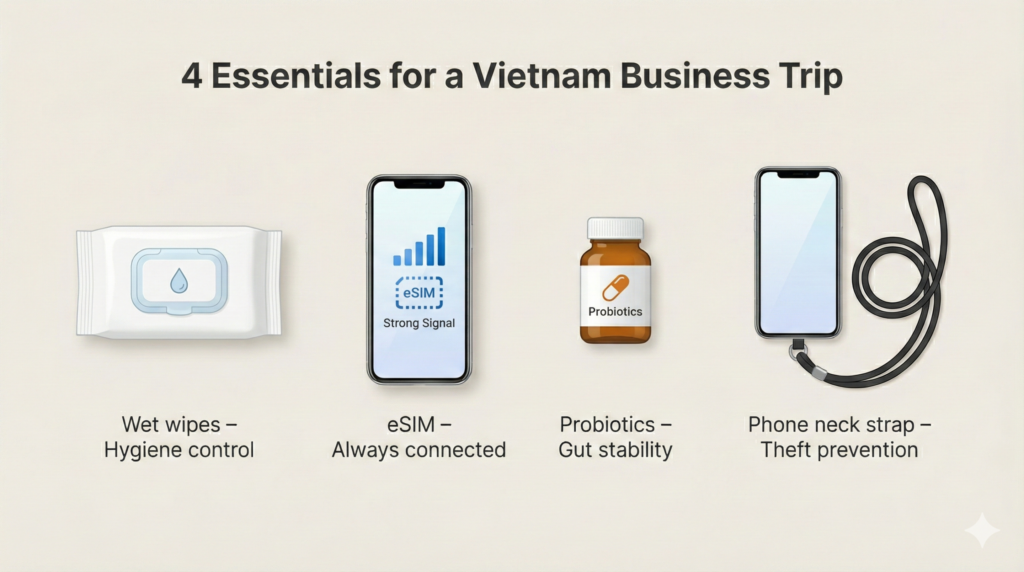
【Essential 1】 Wet wipes
If you plan on only eating at high-end restaurants, you might be fine. However, local restaurants often don’t provide wet towels (oshibori). Vietnam is a tropical country; managing hygiene—wiping sweat, cleaning your hands, or even giving a table a quick wipe—is fundamental. While you can buy them at local convenience stores, they can be surprisingly hard to find when you actually need them. Bringing them from Japan provides much-needed peace of mind.
【Essential 2】 eSIM
Vietnam is a Wi-Fi powerhouse. Compared to Japan, Wi-Fi is available almost everywhere – even in small local shops – and the speeds are surprisingly good. So, technically, you could survive without a data plan, but asking staff for the password at every single stop is a hassle you don’t need. As a business professional, staying “always-on” to respond to urgent matters is key. Having your own SIM is definitely the way to go.
I personally find “World eSIM” to be very cost-effective. You can buy physical SIMs at the airport for about 2,000 yen (a bit of a markup, but acceptable), but preparing an eSIM beforehand is the smoothest way to hit the ground running.
【Essential 3】 Intestinal regulators (e.g., Biofermin)
Many travelers pack “anti-diarrheal” medicine (like Stoppa), but I actually don’t recommend them as your first line of defense. If you happen to get food poisoning from local bacteria or a virus, stopping the “exit” can trap those toxins inside your body, potentially making the situation worse.
The wisdom of living in Vietnam (and abroad in general) is to let the bad stuff out while supplementing with intestinal regulators (probiotics) to help your good bacteria recover. My top tip? Take them every day during your stay as a preventative measure. It keeps your stomach from getting “surprised” by the change in diet.
【Essential 4】 A smartphone neck strap
First, let me be clear: “Vietnam is generally a very safe country.” Violent crime is extremely rare. It is a peaceful place.
However, the one thing you must watch out for is “phone snatching.” This is a specific risk in motorbike-heavy urban areas. The moment you pull out your phone on the sidewalk to check a map, a passing motorbike might snatch it.
Full disclosure: I’ve lost 5 iPhones in 15 years here. That’s an average of one every three years. My solution? Wear a neck strap. Keeping the phone physically attached to you serves as a “visual deterrent”—it shows you are alert and makes you a much less attractive target. Since I started using one, I haven’t been targeted once. I’m currently on my longest record of “phone retention” yet! (Laughs).
What NOT to bring: Shorts and power adapters
Lastly, here are things people often pack but don’t actually need.
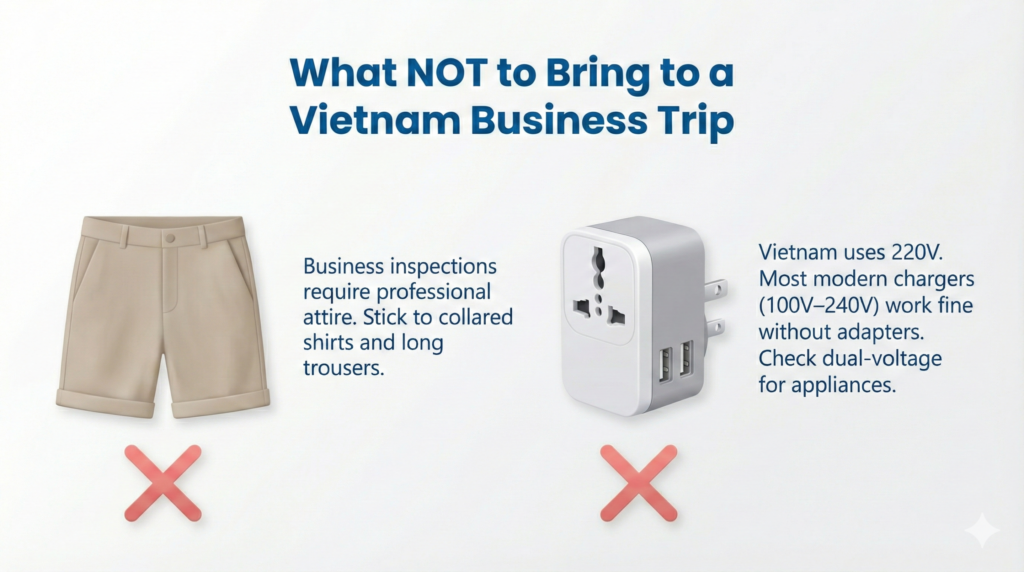
First: Shorts. You might think “tropical country = shorts,” but for a business inspection, they are unnecessary. Vietnamese business professionals care deeply about appearance and grooming. To earn respect, stick to collared shirts and long trousers. Interestingly, while Ho Chi Minh City is in an “endless summer” (around 34°C year-round), it often feels more comfortable than a Tokyo summer, and air conditioning inside buildings is usually cranked up high.
The second item is a power adapter. Most Vietnamese outlets (Type C) are designed to accept Japanese/US plugs (Type A) as well. The only thing to watch is the voltage: Vietnam is 220V (Japan is 100V). Modern PC and iPhone chargers are “100V-240V” compatible, so they work fine. Just be careful with appliances like hair dryers that might not be dual-voltage.
Maximizing the success of your inspection
The items I’ve listed today, combined with the “words” from my previous article, all boil down to two business fundamentals: “Respect for the local culture” and “Risk management.”
The key to succeeding in offshore development, system building, or market entry in Vietnam is understanding the local landscape and standing on the same level as your partners.
However, on a first visit, it’s natural to struggle with the core strategy: “Where should I look?” and “Who should I meet?” You are investing significant time and money into this trip; don’t let it end as just a superficial sightseeing tour.
If you’d like, why not have an online chat with me before you depart?
“What should I be looking for on this trip?” “Which Vietnamese resources match my company’s specific challenges?” “Can you help me find a reliable interpreter?”
Based on my 15 years of experience, I can act as your sounding board. If your goals are clear before you land, the “resolution” of your inspection will be dramatically higher.
【Next step】
The time spent preparing for your flight is what decides the win or loss of your business. Start by applying for a “Pre-departure Online Consultation (Free)” via the link below. I look forward to seeing you in Ho Chi Minh City!
Bounce your inspection plan off me — before you fly
What to verify on this trip, which Vietnamese resources fit your challenges, interpreter arrangements. Based on my years here, I’ll be a sounding board for your inspection plan. The preparation period before your flight is what decides the outcome.
Book a pre-departure consultation →Related reading

Shogo Harada原田 祥吾
CEO · Linnoedge Inc. · LinkedIn↗
Operating IT offshore development and overseas expansion support businesses across two bases: Tokyo and Vietnam. A leader who believes in “Systems over Spirit,” structuring cross-border businesses that often tend to be opaque. Committed to providing “reproducible quality” to organizations and clients rather than relying solely on individual skills.
We cover related ground in on-the-ground market entry support from a local team.
For how we run this as an offshore team, see Linnoedge engineering.