— The Ho Chi Minh City mindset: how to avoid losing out by relying solely on interpreters —
Hello. I’m Shogo Harada from LinnoEdge.
Are you planning a business inspection in Vietnam? Given the “China Plus One” strategy and the abundance of IT talent in this aspiring tech nation, I’ve recently had many Japanese executives reach out to me for guidance.
One of the most common questions I get is: “Is English widely spoken?”
The short answer is: Yes. English communication is significantly more accessible here than in Japan. Your meetings will certainly progress smoothly enough through an interpreter or in English.
However, based on my 15 years of residency, I can say with certainty: to bring home real business results, you must follow the proverb “When in Rome, do as the Romans do.” You need to equip yourself with the “Vietnamese Local Rules.”
Today, I want to share the “7 Phrases (and Mindsets) to Win Trust Locally”—lessons I’ve learned the hard way through system development, lab-type outsourcing, and business entry support in Vietnam.
7 “magic” Vietnamese phrases that can change the atmosphere
“English is fine, so I’ll be okay.” “I have a Vietnamese interpreter, so there’s no problem.”
Are you thinking this? While it’s true that the technicalities of an inspection happen through an interpreter, a few words of Vietnamese—even if clumsy—spoken with effort can be your strongest weapon to win someone over.
Vietnamese people are incredibly warm-hearted and highly value those who make an effort to embrace their culture. These seven phrases are the minimum set I’ve found to be “highly effective” for building trust on the ground.
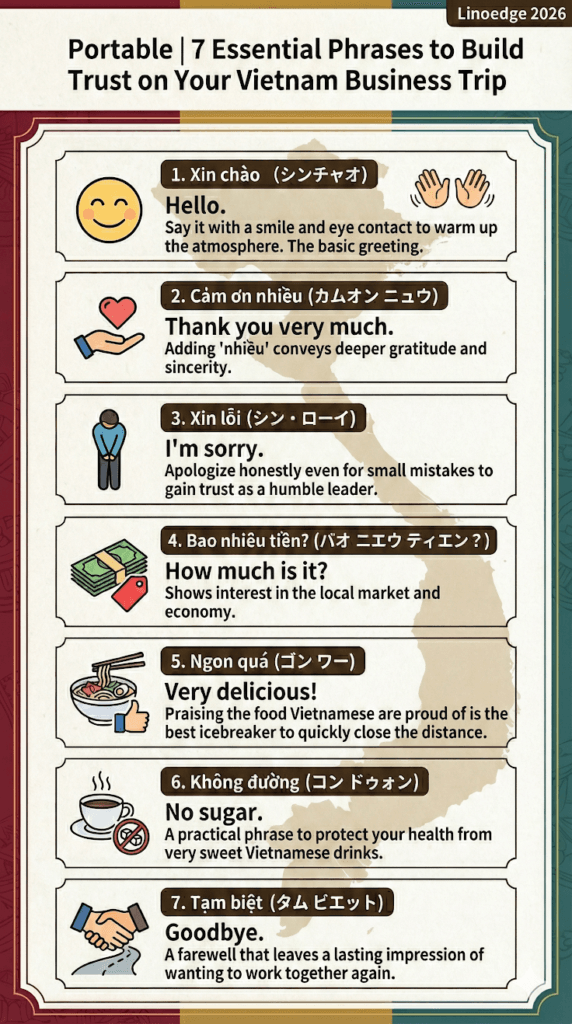
1. Xin chào (Sin chow): Hello
It’s the absolute basic, but saying it while making eye contact and smiling changes the atmosphere instantly. It functions like the Japanese “Otsukaresama-desu”—a switch to warm up the room the moment you arrive. Remember: Xin chào + Smile is the key.
2. Cảm ơn nhiều (Gam-un nyew): Thank you so much
Take the standard “Cảm ơn” (Thank you) and add “nhiều” (much/many). Whether in offshore development or any other field, communicating the depth of your gratitude is the cornerstone of team building. Adding “nhiều” conveys your sincerity. Pro tip: say it twice—Cảm ơn nhiều nhiều—to mean “Thank you very, very much” (it usually gets a smile!).
3. Xin lỗi (Sin loy): I’m sorry / Excuse me
A leader who can apologize sincerely is trusted in Vietnam. If you make a small mistake or fail to catch what someone said, try saying this with a slight nod or a polite gesture. Aim to represent the characteristic Japanese humility in your behavior.
4. Bao nhiêu tiền? (Bow nyew tyen?): How much is it?
During your visit, understanding the local market price at supermarkets or cafes is vital. The act of asking the price yourself sends a message: “I am genuinely interested in this country’s economy.”
Note: In restaurants and cafes, you usually pay at the table. Catch the server’s eye and make a “signing a check” gesture in the air. If you add “Tính tiền” (Ting tyen / Bill, please), you’ll look like a pro.
5. Ngon quá (Ngon wah): Delicious!
If you want to close the distance with someone faster than a self-introduction ever could, use “Ngon quá.” Say this at a dinner or when offered tea and snacks at an office. Being seen as “someone who enjoys Vietnamese food” makes you an immediate ally. Food is a point of immense national pride; praising it is the ultimate icebreaker.
6. Không đường (Kom duong): No sugar
Think of this as a “survival phrase” for your health! By default, Vietnamese drinks are extremely sweet. If you order fresh orange juice at a cafe thinking it’s the “healthy choice,” they might kindly add two tablespoons of sugar. If you aren’t a fan of sweets or are watching your sugar intake, always add “Không đường” to your order.
7. Tạm biệt (Tam biet): Goodbye
A farewell is a promise to meet again. Leaving with a wave and this phrase ensures you leave a lasting impression as someone they want to work with again.
After the words, prepare your strategy
The seven phrases above are the “keys” to showing respect. However, once you unlock the door, you need a strategy for which doors to open (who to meet and what to see).
In my next article, I’ll share “The Vietnam Inspection Packing List: Lessons from a Man Who Lost 5 iPhones in 15 Years.”
“I’m still not sure what exactly I should be verifying during this trip.”
If that sounds like you, why not have a chat with me online before you fly? Whether it’s “Which Vietnamese resources match our company’s challenges?” or “I need help arranging an interpreter,” I can act as a sounding board for your inspection plan based on my years of experience.
The preparation period before your flight is what determines business success or failure. First, please apply for a “Pre-departure Online Consultation (Free)” via the link below. I look forward to seeing you in Ho Chi Minh City.
[Apply for a Pre-departure Online Consultation]
Author Profile: Shogo Harada CEO of [LinnoEdge] Inc. Operating IT offshore development and overseas expansion support businesses across two bases: Tokyo and Vietnam. A leader who believes in “Systems over Spirit,” structuring cross-border businesses that often tend to be opaque. Committed to providing “reproducible quality” to organizations and clients rather than relying solely on individual skills.