
Everyone has their own way of dealing with new tasks.
This isn’t some official best practice.
It’s just something I’ve slowly formed after a few years of working, fixing mistakes, and trying to make my day-to-day work… less exhausting.
I’m writing this mostly for anyone working in project teams — devs, testers, BAs, coordinators. If some parts feel familiar, your team probably works a lot like mine.
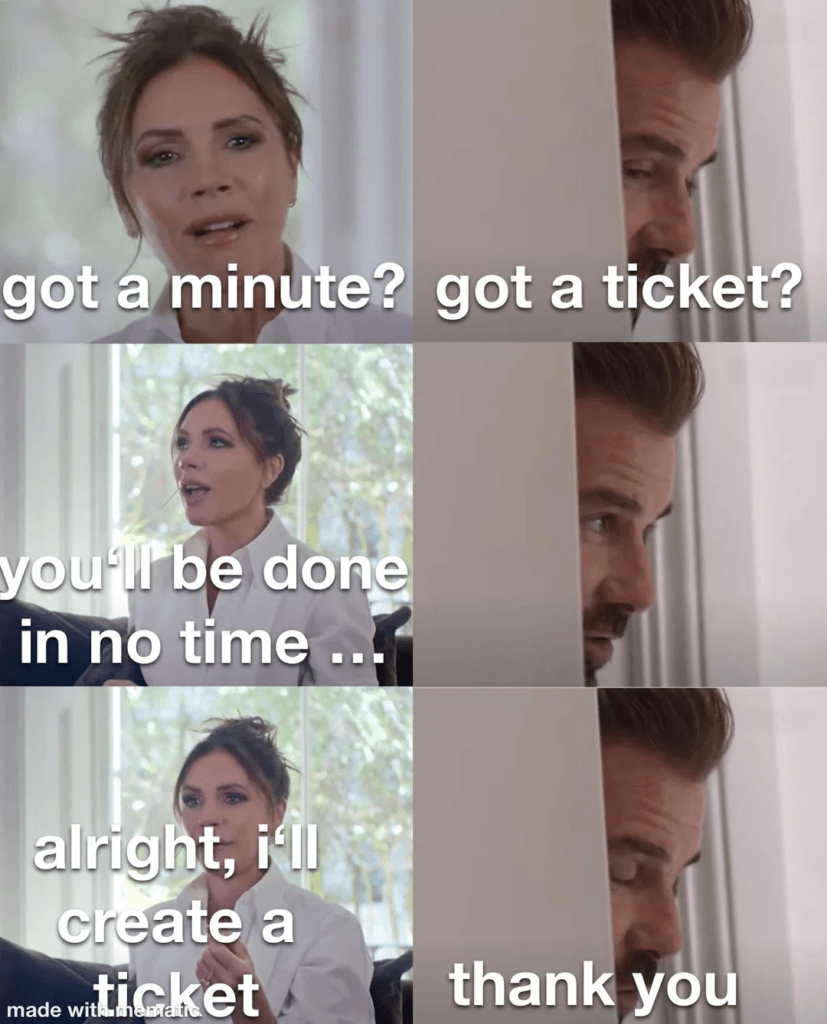
If there’s no ticket, the task doesn’t really exist
Whenever a new request comes in from a client or PM, the first thing that comes to mind is always the same:
Create a ticket!
Not because of process.
Because without a ticket, the task can easily disappear.
Someone mentions it today.
Everyone forgets tomorrow.
A week later nobody remembers what was actually agreed.
A ticket is where the context lives.
If something comes up later, you go back and you know exactly why things were done that way.
Without that, it’s just a conversation.
Not real work.
Try to understand the real intent, not just the words
Once the ticket exists, I read the requirement carefully and try to understand what’s actually behind it, not just what’s written.
If something can be inferred, I infer it.
If it’s too vague, I ask.
When I ask, I usually give two possible interpretations:
“Do you mean A or B?”
It makes it much easier for PMs or clients to answer quickly, and it helps everyone align faster.
Sometimes I use AI tools to rephrase requirements.
But to make AI understand properly, I still have to write the context clearly myself. And most of the time, once the problem is written clearly, half of it is already solved.
Understanding things alone isn’t enough though.
If everyone on the team understands the task differently, things still go wrong.
Anything that might affect others, I bring up early.
Not everyone needs all the details, but at least they should know it exists.
It’s always cheaper to align early than to fix later.
If it’s not clear, I don’t code
This is probably the one thing I’m most strict about.
If it’s not clear, I don’t code.
I’ve seen too many situations where someone spends an entire day building something carefully, only to hear later:
“We don’t actually need that yet.”
That feeling is not great.
So I’d rather be slower at the beginning than move fast in the wrong direction.
Most problems don’t come from bad coding anyway.
They come from unclear requirements.
Once things are reasonably clear, I break tasks into smaller pieces.
Not to make things look nice — just to make estimation and adjustments easier later.
If requirements change, only the affected parts need to change.
Not everything.
Before writing code, I also try to sketch things out first — flow, database, sometimes UI.
Even non-technical team members can then visualize what’s going on and catch issues early.
Our team tends to discuss edge cases quite deeply.
Sometimes a standup goes long because of that.
But once we agree on an approach, implementation usually becomes straightforward.
Spending one extra hour discussing is still cheaper than spending three days rewriting.

Clear first. Then build.
That’s still the least tiring way to work.
Coding while things are vague just means moving faster in the wrong direction.
The real cost of a task isn’t in the code
After implementation starts, I’ve noticed something over time.
The most tiring part of a task isn’t difficult code.
Even complicated logic can eventually be solved.
What drains more energy is having to re-understand the same problem again and again.
You start working on something.
Then you get pulled into another task.
A few days later you come back and suddenly can’t remember why you chose this direction, what trade-offs you made, or what assumptions were there.
Every time that happens, you basically reload the entire context from zero.
That’s what really consumes energy.
Because of this, I try to keep context as continuous as possible.
Once I understand something and start working on it, I try to leave things clear enough that if I have to stop midway, I can come back later and continue without rethinking everything.
Naming, code structure, small implementation decisions — if they aren’t made clear at the time, a few days later the code can feel like it was written by someone else.
Finishing a task isn’t just about delivering the current requirement.
It’s about leaving behind a state where either you or someone else can continue without starting from scratch again.
The fewer times you have to “re-understand from zero,”
the less exhausting the work becomes.
Honestly, that’s what drains me the most — not difficult code, but having to understand the same thing repeatedly.

When blocked
In reality, responses don’t always come quickly.
PMs get busy. QA might take time.
I try to resolve as much as possible on my own first.
If there are multiple valid directions, I raise them early.
If something can be handled in chat, we handle it there. Otherwise, we bring it up in standup.
I don’t like being stuck waiting.
But I also don’t like asking questions before thinking things through.
Handle what you can yourself.
But don’t stay stuck in silence for too long.
Production hotfixes are different
Hotfix situations are when it’s easiest to be careless.
Which is exactly why discipline matters most.
Production isn’t a place for experimentation.
We usually follow a simple flow:
find the root cause → report it → propose a fix → confirm → fix locally → test → confirm release → deploy.
Whether the bug is big or small, we try to stick to that structure.
When clients see that things are handled calmly and clearly, they trust the team more.
And internally, things stay much less chaotic.
The more urgent it is, the more disciplined we try to be.
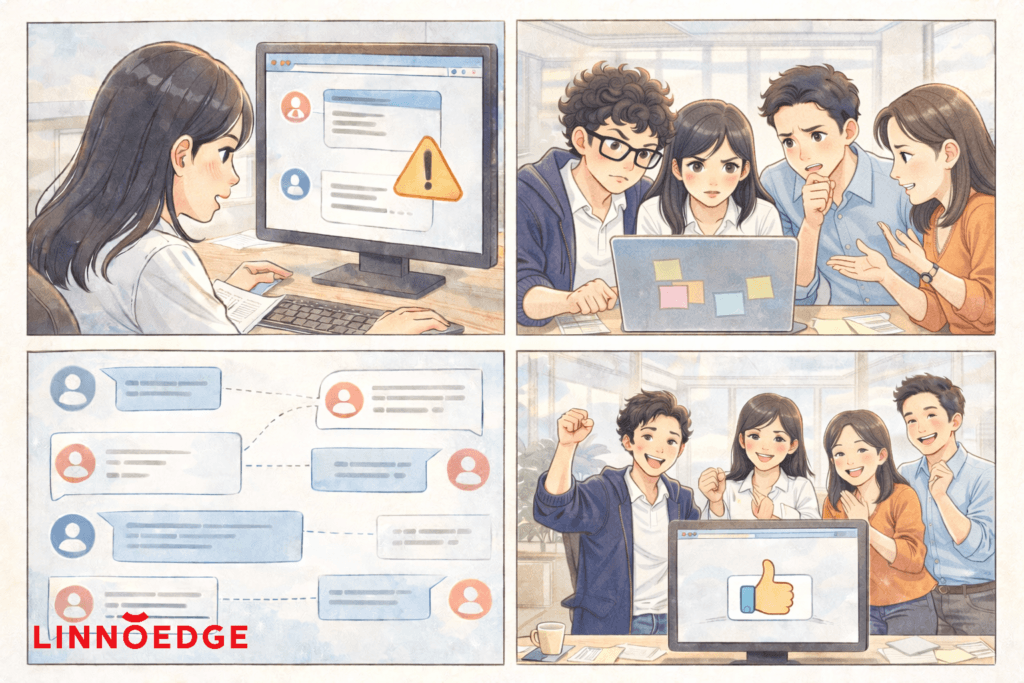
Closing
There’s nothing particularly advanced about any of this.
I just try to make things clear early, keep things organized, and reduce how often something has to be redone.
Every team works differently.
But one pattern seems to hold almost everywhere:
The more ambiguity at the beginning,
the higher the cost later.
Clear early, and everything becomes a bit less exhausting.Anyway.
Back to coding.